
1. Base Salary Ranges by Role
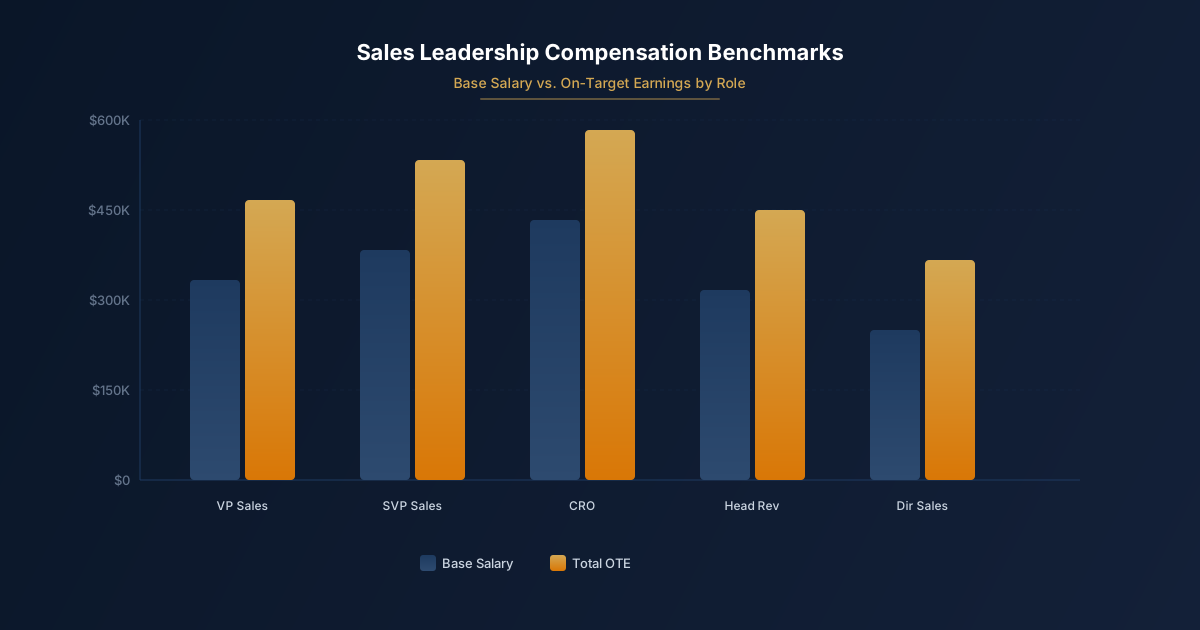
Sales executive compensation varies dramatically by seniority level. Here's what companies are paying in 2026, based on disclosed salary ranges from thousands of job postings.
The data shows three distinct compensation tiers in sales leadership:
- VP Sales: $166K-$251K base (597 postings)
- SVP Sales: $200K-$300K base, typically at companies with $50M+ ARR
- CRO / Chief Revenue Officer: $250K-$400K base, with total comp often exceeding $500K
Explore Salary Data by Seniority
Full salary data from 597 postings
Senior VP compensation data
Chief Revenue Officer pay
Compare across levels
2. OTE Structure & Variable Compensation
On-Target Earnings (OTE) represents total cash compensation when a sales leader hits 100% of their targets. For VP Sales and above, the typical OTE multiplier ranges from 1.5x to 2x base salary.
The structure shifts as you move up the seniority ladder. VP Sales roles tend toward a 60/40 or 70/30 base-to-variable split. CRO roles often move to 75/25 or even 80/20, reflecting the broader strategic scope of the role beyond direct quota carrying.
Complete OTE breakdown
Definition and examples
How attainment affects pay
Compensation framework
3. Location-Based Pay Premiums
Location remains one of the strongest predictors of sales executive pay, even as remote work reshapes the market. San Francisco and New York consistently pay 20-40% above the national median, while remote roles have settled into a middle tier that's competitive but below the top metros.
All Location Data
Highest paying metro
Strong financial sector
SaaS hub premium
Midwest leader
Tech corridor
West Coast data
Growing tech market
Southeast hub
Austin & Dallas
Distributed comp data
4. Compensation by Company Stage
Company stage affects not just the dollar amount but the entire structure of your compensation. Early-stage companies offer lower base salaries offset by larger equity stakes and the potential for outsized returns. Growth-stage companies provide the best balance of competitive cash and meaningful equity. Enterprise and public companies maximize cash but dilute equity upside.
$150K-$220K base + large equity
Growth stage comp data
Scaling stage data
Late growth data
Pre-IPO compensation
$200K-$350K + RSUs
5. Equity & Long-Term Incentives
Equity is where the real variance lives in sales executive compensation. A CRO at a Series B company might have a $275K base salary, comparable to a public company peer, but with 0.5-1.5% equity that could be worth $2M+ at exit.
The key variables to evaluate:
- Options vs RSUs: Pre-IPO companies grant stock options (you pay a strike price); public companies grant RSUs (no cost to you)
- Vesting schedule: Standard is 4 years with a 1-year cliff, but acceleration clauses in a change-of-control event are worth negotiating
- Percentage of company: CROs at Series A typically get 0.5-2%, shrinking to 0.1-0.5% by Series C
- Refresh grants: Public companies issue annual refresh grants; private companies rarely do
Detailed comparison
Equity negotiation tactics
What to check on equity
6. Negotiation Tactics
Sales executives should negotiate their own compensation with the same rigor they apply to deal strategy. Here's what the data tells us about effective negotiation:
- Lead with base salary. OTE multipliers are typically fixed. A higher base lifts your entire compensation package.
- Use location data. If you're in a premium market, benchmark against local data, not national averages.
- Negotiate equity terms, not just amount. Acceleration clauses, exercise windows, and refresh grants often matter more than the initial grant size.
- Ask about quota construction. A $500K OTE with an unattainable quota is worse than $400K OTE with a well-built plan.
Complete playbook
C-level compensation data
Remote comp benchmarks
7. Industry-Specific Compensation
Compensation varies significantly by industry vertical. Cybersecurity and fintech consistently pay above average, while healthcare and energy offer more stability and longer deal cycles that affect variable compensation structures.
Highest-paying vertical
Banking & fintech data
Medtech & healthtech
Climate & energy tech
Frequently Asked Questions
What is the average CRO salary in 2026?
CRO compensation varies by role scope, company stage, location, and whether the employer reports base or OTE. Use the disclosed ranges, sample size, and date range shown with each benchmark.
What is the average VP Sales salary?
VP Sales base salaries average $166K-$251K based on 597 job postings analyzed by The CRO Report. San Francisco commands the highest premiums, while remote roles offer competitive packages averaging $195K-$285K.
How does company stage affect sales executive pay?
Company stage dramatically affects compensation structure. Seed/Series A companies offer lower base salaries ($150K-$220K) but larger equity grants, while enterprise/public companies pay higher base ($200K-$350K) with RSUs adding 15-25% on top.
Should I negotiate base salary or OTE?
Focus on base salary first. According to The CRO Report's data, OTE multipliers typically fall between 1.5x-2x base and are less negotiable. A higher base creates a higher floor regardless of quota attainment.
Get Weekly Compensation Intelligence
New salary data, executive moves, and market analysis every week from The CRO Report.
Subscribe Free