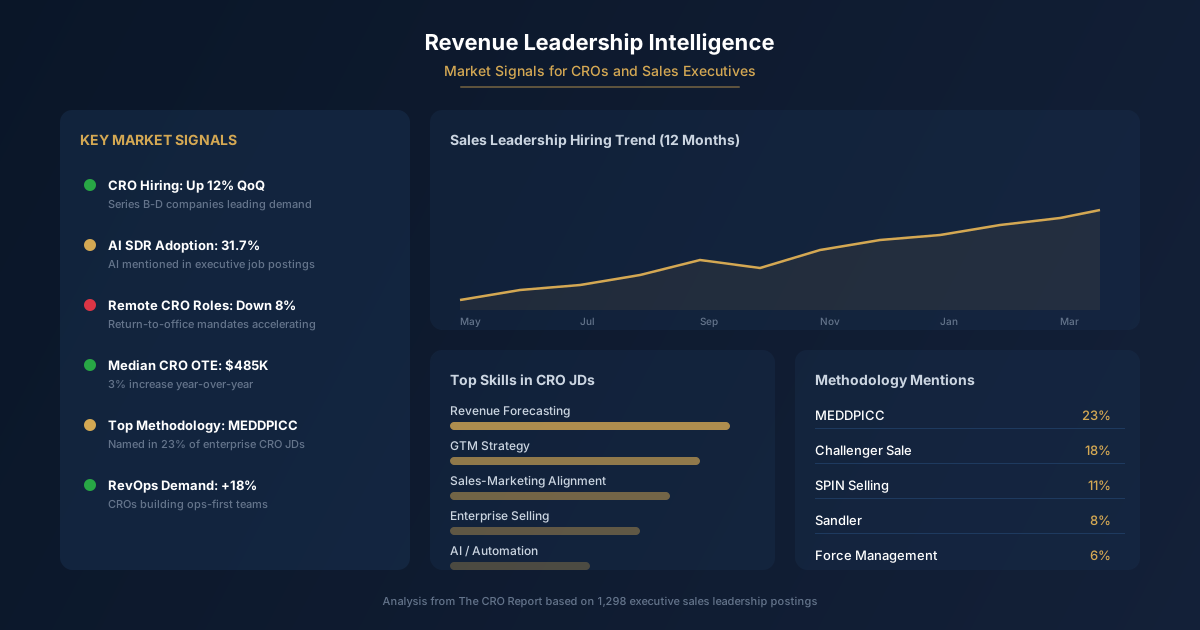
April 2026 Update: OTE structures are shifting. More companies are moving to 60/40 base/variable splits (up from the traditional 50/50) to attract senior talent in a competitive market. Accelerators above quota are also getting more generous, with top performers earning 2.5-3x on deals above 120% attainment at Series C+ companies.
VP Sales OTE commonly lands at $279,000 to $420,000 at a 60/40 split, based on modeled compensation from tracked executive-sales postings. CRO Report VP Sales OTE That figure is useful, provided you know what it is: a model built from disclosed base salaries, not a promise that every employer puts in writing.
The distinction matters because compensation conversations get sloppy fast. A recruiter may quote OTE as though it is guaranteed cash. A candidate may compare an OTE figure from one company with a base salary from another. A hiring manager may offer an aggressive variable plan without explaining whether the quota gives anyone a plausible route to earn it.
The salary data is firmer. VP Sales base runs from $167,295 to $251,443 across the tracked market. CRO Report VP Sales OTE OTE adds a variable-pay assumption to that disclosed base. It is a useful way to compare roles, but it should never erase the difference between money stated in a posting and money contingent on performance.
TLDR
VP Sales OTE is usually modeled because postings disclose base salary far more often than total target compensation. A 60/40 plan puts more pay at risk than a 70/30 plan. Treat equity separately, then ask whether quota, territory, and payout rules make the variable number credible.
Key Takeaways
VP Sales OTE combines base salary with target variable compensation.
A modeled range is different from compensation explicitly disclosed by an employer.
A 60/40 split puts more income into variable pay than a 70/30 split.
Equity usually sits outside OTE and should be valued separately.
The payout mechanics matter as much as the headline number.
What VP Sales OTE Means
OTE means on-target earnings. It is the total cash compensation a VP of Sales should earn when they hit the plan’s target. The phrase sounds precise, which is why it gets abused.
A clean OTE calculation has two parts: base salary and target variable pay. The base is fixed cash compensation. The variable component is the commission, bonus, or incentive payment attached to reaching the agreed performance target. Add them together and you have the advertised OTE.
The problem is that many job descriptions publish only the base. Base salary is disclosed 54.8% of the time, while OTE is rarely disclosed in the underlying executive-sales postings. CRO Report VP Sales OTE That leaves candidates, recruiters, and compensation analysts to infer the rest from common pay splits.
That inference can still be valuable. It makes a large set of roles comparable when employers disclose different amounts of information. It also forces a useful question: how much of this compensation is guaranteed, and how much depends on a sales plan the company has not shown you?
A VP Sales role with a high OTE can be a strong offer. It can also be a mediocre base salary with a large amount of risk stuffed into the variable plan. Those are different jobs, even when the headline compensation looks similar.
The right comparison starts with the base. VP Sales base runs from $167,295 to $251,443.CRO Report VP Sales OTE That is disclosed compensation, drawn from actual postings. The OTE range is then modeled using a standard split, which makes it directional rather than contractual.
The analysis uses 704 executive sales postings. CRO Report VP Sales OTE That matters because a modeled compensation range should be grounded in observed salary data, not a recruiter’s favorite anecdote or a compensation blog that decided every sales leader earns the same way.
For a buyer evaluating leadership talent, this framing keeps the conversation honest. You can use OTE to benchmark the market. You should still ask what is actually written into the offer, whether the plan has been achieved before, and what would need to happen for the executive to earn the full variable amount.
How 60/40 and 70/30 Splits Change OTE
The split tells you how OTE is divided between fixed and variable pay. It is the part of the package that determines who carries more of the revenue risk.
A 60/40 split means the base represents most of the target cash compensation, while the remaining share depends on results. A 70/30 split places more of the compensation in base salary and less in variable pay. Neither structure is automatically better. The right answer depends on the role, the company stage, the quality of the sales motion, and the amount of uncertainty built into the quota.
For VP Sales roles, modeled VP OTE is $279,000 to $420,000 at a 60/40 split.CRO Report VP Sales OTE The same base salary can produce a noticeably different OTE figure when the variable component changes, but that does not mean the executive is suddenly more valuable. It means more of the target compensation is tied to attainment.
A 60/40 plan asks a sales leader to accept meaningful exposure to the business’s ability to create pipeline, close deals, retain customers, and define a quota that can be reached. That may be a fair trade at a company with a mature sales process and a history of paying plan. It is a much harder sell at a company still trying to figure out which customer will buy.
A 70/30 plan shifts more certainty into the base. The executive has less upside through target variable pay, but also less income at risk if the company misses product, marketing, or hiring assumptions. That often fits roles where the VP is being hired to build the operating system before the machine is ready to run at full speed.
The CRO data uses that latter split. Modeled CRO OTE is $331,000-$432,000 at a 70/30 split.CRO Report VP Sales OTE The role carries broader responsibility, but the split also reflects a practical truth: a senior commercial leader can influence revenue without controlling every input that determines it.
Seniority tier
Base salary treatment
OTE treatment
Common split
VP Sales
Disclosed range
Modeled from base
60/40
CRO
Disclosed range
Modeled from base
70/30
Equity
Separate from cash pay
n/a
n/a
The table is a starting point, not a compensation rulebook. Companies often use different mixes for the same title. A VP brought in to manage a large, established team may have a more variable-heavy plan than a VP hired to stand up a new market. A title tells you less than the job’s actual mandate.
Pay attention to the mechanics behind the split. Is variable pay based on bookings, revenue, gross margin, new logos, renewals, or a blend? Is the executive held accountable for a number that relies on lead volume from marketing or implementation capacity from another team? Does the plan pay monthly, quarterly, or only after revenue clears some internal hurdle?
You can have a generous split on paper and a plan that behaves like a locked door. The important question is whether the company has built a realistic route to target attainment.
Accelerators complicate the picture further. Accelerators can reach 2.5-3x above 120% attainment.CRO Report VP Sales OTE That creates genuine upside for exceptional performance, but it should not be used to dress up a weak target plan. Accelerators matter after the executive reaches plan. The first question is whether the plan itself is attainable.
Base Salary, Variable Pay, and Equity
Cash compensation is usually the easiest part of a VP Sales offer to understand. Equity is where comparison gets murkier.
Base salary is paid regardless of sales attainment, subject to normal employment terms. Variable pay is contingent on performance and plan rules. OTE adds those two cash components together. Equity is commonly separate.
That answer should settle the “does OTE include equity” question: usually, no. OTE is generally a cash-compensation figure. An equity grant may be economically meaningful, especially at an earlier-stage company, but it is not cash compensation and does not belong in the OTE calculation unless the employer explicitly defines its package that way.
Keeping equity separate prevents bad comparisons. A company can offer a strong equity package alongside a lower cash OTE. Another can offer a higher cash figure with little ownership. Neither package is automatically superior. They carry different risk, liquidity, dilution, tax, and timing considerations.
The danger comes when equity is used to fill a cash-compensation gap without enough detail to assess its value. A percentage, option count, or grant value tells you little by itself. You need the strike price, vesting terms, ownership on a fully diluted basis, the company’s financing history, and a candid view of what liquidity could look like.
A sales executive should also separate equity from the variable plan in their own mental model. Equity is a long-duration bet on the company. Variable compensation is payment for operating performance in the current role. Mixing them lets an employer make a low base or questionable commission plan look more attractive than it is.
The same discipline applies to benefits, sign-on payments, severance, and draw arrangements. Those may matter a great deal, but they are not automatically part of OTE. Put each element in its own column before comparing offers.
For teams buying sales technology, the underlying economics are similar. The salary market has to support the revenue plan you expect a leader to execute. VP Sales base runs from $167,295 to $251,443, and the cost of the broader sales stack belongs in the model too, including ZoomInfo pricing and data enrichment tools. CRO Report VP Sales OTE
That is not an argument for buying every tool in sight. It is an argument for avoiding a familiar mistake: hiring an expensive sales leader, setting a large target, then starving the team of the data and systems required to build pipeline. A VP cannot compensate for a broken go-to-market motion with a larger commission rate.
How to Use Modeled Compensation Ranges
A modeled range is best used as a benchmark. It gives you a way to understand the likely cash package for a role when employers disclose salary but omit OTE. It does not replace a written plan.
Start by identifying what is disclosed. If the job posting lists base salary, you have a real number. If it lists OTE, check whether the employer explains the split, quota, payout timing, ramp treatment, and accelerators. If it lists neither, the title alone is not enough to make a useful comparison.
Then examine the role’s context. Seniority, company stage, and metro all shape cash compensation. A VP asked to inherit a mature enterprise team has a different assignment from a leader asked to create a repeatable motion from scratch. The compensation should reflect that difference, especially the amount of variable pay placed at risk.
The tracked data supports using base salary as the anchor. Base salary is disclosed 54.8% of the time.CRO Report VP Sales OTE That is why modeled OTE should be described as modeled every time it appears. Calling it a disclosed package would turn a useful benchmark into a misleading claim.
For a candidate, modeled compensation helps you prepare the right questions. Ask how many leaders have hit target under the current plan. Ask whether quota changed during the prior period. Ask what portion of the pipeline comes from the company versus the sales organization. Ask how departures, territory changes, and credit disputes are handled. The answers will tell you more than the OTE headline.
For a company, the range helps with budget planning and hiring calibration. If the market expects a VP Sales cash package built from a credible base and a credible variable plan, a low base paired with an aggressive target will narrow the candidate pool. The people most comfortable with that offer may be chasing upside. They may also be avoiding questions about whether the underlying business can support it.
The most useful compensation discussion ends with a simple distinction. Salary data tells you what the company is prepared to guarantee. OTE tells you what the company expects the executive to earn at plan. Equity tells you what the company is asking the executive to bet on.
Those are three separate conversations. Keep them that way.
A capable VP Sales hire will scrutinize the plan with the same care they bring to a pipeline review. If the company cannot explain how an executive reaches target, the OTE figure is decoration. Can the business show the route from territory and pipeline to a payout the leader would actually expect to receive?
Based on 636 VP-level roles tracked by The CRO Report, average base salary ranges from $167,295 to $251,443. Applying the industry-standard 60/40 base-to-variable split, modeled OTE falls between $279,000 and $420,000. Actual OTE varies by company stage, metro, and individual negotiation. Series C/D companies and San Francisco roles push modeled OTE above $500,000.
What percentage of VP Sales comp is variable?
The industry standard for VP Sales is a 60/40 split: 60% base salary, 40% variable compensation tied to quota attainment. CROs typically run at 70/30 (less variable risk). SVPs are often at 65/35. Early-stage companies (Seed through Series B) frequently use 50/50 splits with more aggressive upside. Enterprise and public companies trend toward 70/30 for greater comp stability.
Do VP Sales job postings show OTE?
Rarely. Of 1,349 executive sales postings tracked by The CRO Report, 54.8% disclose any salary data, and nearly all of those show base salary only. OTE, variable comp structure, accelerators, and equity are almost never listed in job postings. These components are typically discussed during the interview process or presented at the offer stage. Pay transparency laws in states like California, Colorado, and New York require salary disclosure, but the mandates focus on base salary or salary ranges rather than total compensation.
How does VP Sales OTE compare to CRO OTE?
VP Sales modeled OTE ranges from $279,000 to $420,000 (at a 60/40 split on $167K-$251K base). CRO modeled OTE ranges from $332,000 to $432,000 (at a 70/30 split on $232K-$302K base). The gap is roughly $52,000 at the low end and $12,000 at the high end. CROs carry a higher base but take less variable risk as a percentage of total comp, which compresses the OTE differential at the top of the range.
Is VP Sales OTE higher at startups?
At the ceiling, yes. Series C/D companies show base ranges of $222,046 to $314,444. With 60/40 splits common at that stage, modeled OTE runs $371,000 to $525,000. Seed/Series A companies with 50/50 splits model to $386,000-$514,000 OTE on base of $193K-$257K. The trade-off: startup variable comp carries higher attainment risk because quotas are built on less historical data, and equity (which can be the largest comp component at early-stage companies) is illiquid and uncertain in value.
The CRO Report newsletter delivers salary benchmarks, OTE modeling, and hiring trend data for VP Sales and CRO roles. Updated weekly from live posting data.
Methodology & Disclosure: Base salary data comes from 704 executive sales job postings with disclosed compensation, tracked weekly by The CRO Report out of 1,349 total postings (54.8% disclosure rate). OTE figures are modeled by applying industry-standard base/variable splits to disclosed base salary ranges. These modeled OTE numbers are not sourced from job postings. Actual OTE, variable comp structure, accelerators, equity, and benefits are almost never disclosed in postings and vary by company, role, and individual negotiation. The variable splits used (60/40 for VP, 65/35 for SVP, 70/30 for CRO, 50/50 for early-stage) represent common market benchmarks and may not reflect any specific company's comp plan. Metro data reflects the posting's listed location. Remote roles are categorized separately. Updated February 1, 2026.
The CRO Report is run by Rome Thorndike, VP Revenue at Firmograph.ai. 15+ years in B2B sales leadership including Salesforce, Microsoft, Snapdocs, and Datajoy (acquired by Databricks). MBA from UC Berkeley Haas.