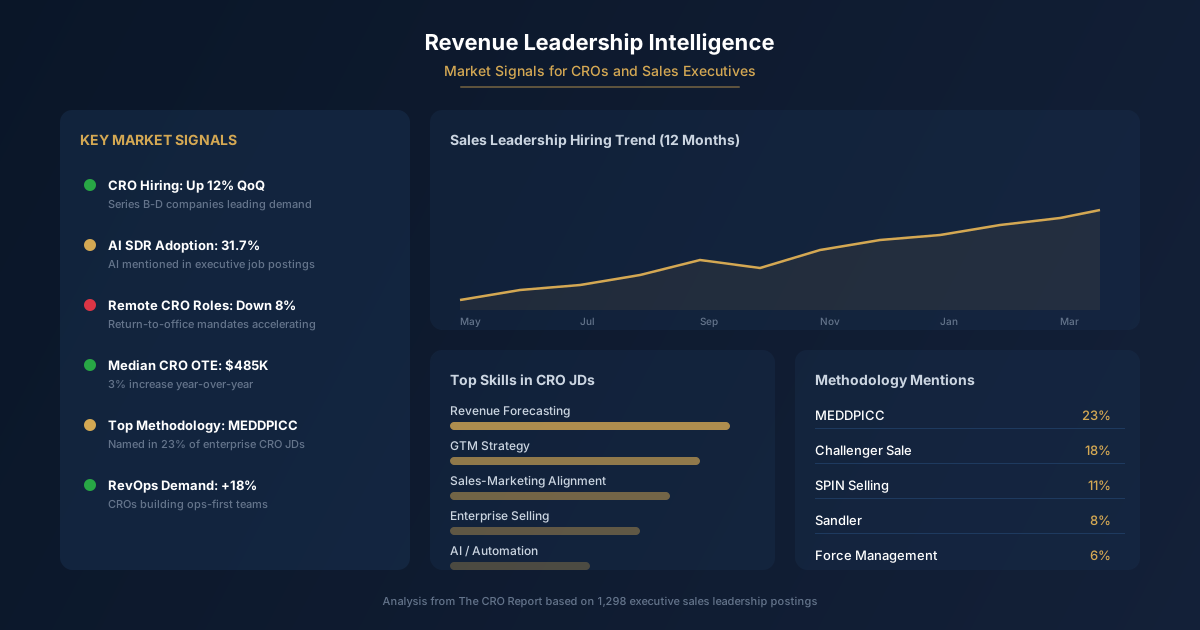
April 2026 Update: CRO hiring has picked up in Q1 2026. We are seeing more PE-backed companies creating the CRO title for the first time, particularly in the $50M-$150M ARR range. Equity packages at late-stage companies have shifted toward RSUs over options, and the average CRO base at enterprise companies has climbed to $285K-$310K. The gap between CRO and VP Sales comp still widen.
CRO salary can run from $50,000 to $600K in a dataset of 1,349 documented executive sales postings. That spread is the point. The chief revenue officer title tells you very little without the company’s stage, sales model, targets, and willingness to pay for proven revenue leadership.
The CRO Report reviewed 704 roles with disclosed compensation across executive sales postings. A posted salary is useful evidence, but it is still only part of the offer. Base pay, bonus mechanics, equity, severance, and the quality of the revenue engine all shape what a CRO job is worth.
Candidates often focus on the highest number in a range. Companies often focus on the base they can afford today. Both approaches miss the harder question: what is the company asking this person to fix, build, or scale, and does the offer pay for that risk?
A CRO joining a functioning revenue organization has a different job from one walking into missed forecasts, weak pipeline coverage, and a sales team that has learned to ignore leadership. Those roles can carry the same title. They should not carry the same expectations.
TLDR
CRO salary spans $50,000 to $600K across the documented posting data. Base pay gives you a starting point, not an answer. Read the bonus plan, equity terms, revenue conditions, and decision rights together before deciding whether an offer pays for the job.
Key Takeaways
The documented CRO salary range runs from $50,000 to $600K.
A $302K base can be useful context, but it does not tell you whether the variable plan is attainable.
Bonus and equity deserve the same scrutiny as base pay.
The best offer matches the company’s revenue reality with the scope of the job.
CRO Salary Range
The data includes 26 C-Level roles, which helps explain why a single “average CRO salary” is a blunt instrument. Executive sales titles get used across companies with radically different needs. One business wants an operator to improve forecast discipline. Another wants a market-facing executive to assemble a sales organization from scratch. A third wants someone to repair a broken handoff between product, marketing, customer success, and sales.
Those are different jobs with different odds of success.
The disclosed figures show a CRO salary range from $50,000 to $600K. The low end should not be read as a normal benchmark for an experienced revenue leader, and the high end should not be treated as an automatic market rate. Each is evidence that title alone fails as a pricing mechanism.
A company with a small base may be offering a job that is part-time, advisory, transitional, or structured around a very different mix of cash and upside. A company paying near the top of the range may have a large revenue base, a difficult growth target, a mature board, or a pressing need to stop losing ground.
The useful comparison is not “what does a CRO make?” It is “what is this company buying?”
Ask what performance burden and organizational risk sit behind the number
The most important distinction is between a company that wants a revenue executive and a company that wants a magician. The first has a defined market, a sellable product, enough evidence in the pipeline, and a board that understands the time required to improve a commercial system. The second has a vague target, a weak narrative, and a hiring plan built around finding someone to absorb the consequences.
Cash does not solve the second problem. It can make the job harder to leave, though.
If you are comparing roles, use the sales salaries data as a wider reference point alongside the 1,349 postings in this CRO dataset. A CRO offer should make sense relative to the executive responsibility involved, rather than merely relative to another title in isolation.
What Changes CRO Base Pay
Base pay reflects more than experience. It reflects the company’s confidence in its plan, its ability to pay, and the amount of commercial uncertainty it expects the incoming CRO to carry.
The documented page includes a $302K figure. That number is helpful context for a candidate trying to place an offer, but it cannot tell you whether the role is attractive. A base can look strong while the variable plan is fictional. It can look modest while the company has a clean sales motion, a credible target, and equity that is worth taking seriously.
Start with scope. Does the CRO own new business only, or the full revenue organization? Is customer expansion part of the job? Does marketing report into the role? Is sales development separate? Are partnerships expected to create material revenue, or are they there because someone put “ecosystem” into a board deck?
Every added responsibility changes the job. It should change the offer too.
Then look at the existing team. A CRO inheriting capable leaders, clear territory design, reliable reporting, and a product customers can understand has room to improve the system. A CRO inheriting open leadership seats, inconsistent data, and a churn problem is taking on a turnaround. Turnarounds deserve explicit mandates, realistic targets, and enough cash to make the risk rational.
Company stage matters, but stage labels are often too neat. Some smaller companies have an unusually disciplined sales motion. Some larger ones have spent years disguising disorder with hiring. Ask how revenue is produced today. Ask where deals get stuck. Ask whether the company can explain why it wins and loses.
That conversation tells you more than a glossy title.
The 704 disclosed compensation roles are useful because disclosed pay gives candidates a factual starting point. The next step is to separate market context from role context. Market context tells you what companies have posted. Role context tells you whether this company has designed a job that can be done.
A base salary should also match the amount of authority the company is granting. If the CRO owns the target but cannot shape headcount, pricing, sales compensation, territory design, or hiring, the company has created an accountability trap. The offer may still be high. The job may still be wrong.
The same problem shows up when founders want an executive hire but remain unwilling to decide. Revenue leadership requires choices about customer segments, product gaps, deal quality, and what the company will stop selling. A CRO cannot build a repeatable sales motion around a founder’s preference to keep every option alive.
You do not need perfect conditions. You need a company that can identify its constraints without pretending they are somebody else’s job.
For candidates looking at the next role rather than a single compensation package, the sales jobs market is worth reviewing alongside the $302K documented figure. The job description often reveals whether a company is paying for leadership or advertising for rescue work.
How to Evaluate Bonus and Equity
Variable pay is where offers become slippery.
A bonus target has value only if the company can explain how it is earned. Candidates should be able to trace the path from target to territory, pipeline, conversion assumptions, staffing, and deal capacity. If nobody can explain that path, the plan is not a plan. It is a hope with a percentage attached.
Ask what revenue measure determines payment. New bookings, recurring revenue, total contract value, recognized revenue, gross profit, renewal performance, and company-wide outcomes each create different incentives. The measure should fit the actual job. A CRO responsible for the entire commercial system should be wary of a plan that rewards a narrow metric while leaving the rest of the system underfunded.
Ask whether targets were hit before. Ask what changed when they were missed. Ask whether the company adjusted territories, pricing, product priorities, or staffing. A leadership team that can discuss missed plans plainly is easier to work with than one that insists every prior miss was an execution problem.
Equity deserves the same directness. The grant may be meaningful, but its value depends on ownership percentage, vesting, dilution, preference stack, liquidity prospects, and the company’s ability to reach its next milestone. A large-looking option count can be thin ownership. A smaller grant can be more valuable if the company has a business that customers want to buy.
This is where candidates should resist trying to reduce the offer to a single annual number. Cash is cash. Equity is a long-duration bet on the business and on the people making decisions after you join. Treating them as interchangeable makes it easy for a company to overstate what it is offering.
The $600K documented ceiling is a reminder that headline compensation can hide very different structures. A large package may carry aggressive performance conditions, substantial travel, an inherited team problem, or an expectation that the CRO will replace multiple functional leaders. None of those terms are necessarily bad. They should be visible.
There is also a less glamorous issue: when payment happens. A plan can be technically generous while delaying payment through approval gates, collections rules, or board discretion. Read the language. Find out who can change the plan. Find out whether the company has changed it before.
If an employer cannot answer basic questions about bonus mechanics, equity ownership, or acceleration on departure, that uncertainty belongs in your valuation of the offer. It does not disappear because the headline number is attractive.
Reading a CRO Offer
Read the offer as an operating document, not a compliment.
Start with the job itself. What does the company expect to be different after you arrive? A stronger forecast is not the same as a larger pipeline. A larger pipeline is not the same as higher win rates. Higher win rates are not the same as durable revenue. The company should be able to describe the problem in concrete terms.
Then compare the mandate with the resources. Does the offer include authority to hire? Can you change compensation plans? Can you influence pricing? Is there budget for the systems needed to run the organization? Does the board agree on the target customer and sales motion?
A CRO who is expected to own revenue needs access to the decisions that create revenue.
The data’s $50,000 to $600K range gives you permission to reject simplistic salary advice. There is no universal number that tells you whether an offer is fair. A lower cash offer can be sensible when the mandate is clear, the team is strong, and the upside is credible. A high cash offer can be a warning that the company knows the assignment is unusually hard.
Look for alignment between the company’s story and its terms. A business that says it wants a strategic CRO but offers no real decision rights is telling you something. A company that wants a builder but expects immediate mature-company results is telling you something else. A board that says it values long-term growth but structures all incentives around a short-term milestone has already chosen its priorities.
The most useful questions are usually plain ones. What would make the company say this hire worked? What has prevented that outcome so far? Which decisions can the CRO make without escalation? What happens if the market, product, or hiring plan does not cooperate?
Good answers will not make the job easy. They will make the risk legible.
The CRO title attracts candidates who enjoy responsibility. That can become a weakness when candidates confuse responsibility with control. A hard job with the right authority can be worth taking. A hard job without authority turns into an expensive lesson.
The offer should also tell you how the company behaves when things go wrong. Look at severance, equity treatment, variable-pay disputes, and the terms around a change in control. These are not details to postpone until after the exciting conversations. They are the conditions that matter when the relationship gets difficult.
A company that has built a thoughtful offer usually has a more thoughtful view of the role. That does not guarantee a good outcome. It does show whether the company understands the difference between hiring a CRO and handing someone a target.
Based on 26 C-Level sales roles tracked by The CRO Report, the average CRO base salary ranges from $231,873 to $302,246. The median sits at $220,450-$263,750. The full range spans $50,000 to $600,000, reflecting significant variation based on company stage, location, and role scope.
How much do CROs make in total compensation including bonus and equity?
CRO total comp typically runs 2x-4x base salary depending on company stage. Variable comp is usually 40-50% of base, putting estimated OTE at $324K-$453K for an average CRO. Equity adds significantly at startups (1%+ at seed, 0.25-0.75% at Series C/D) and through RSUs at public companies. A CRO at a well-funded Series C could see total comp of $600K-$1M+ when equity is included.
Do CROs in San Francisco make more than other cities?
Yes. San Francisco leads with average base ranges of $244,452-$347,218. Seattle follows at $200,909-$296,696, then Boston at $201,227-$282,527. New York comes in at $180,780-$250,499. Remote CRO roles average $151,533-$217,341, roughly 14% less than New York.
How does CRO salary change by company stage?
Dramatically. Seed/Series A CRO roles average $192,955-$257,169 in base but offer larger equity grants. Series C/D averages $267,667-$335,000. Enterprise/Public companies average $199,133-$263,750 in base but add RSU packages. Late-stage private companies pay the highest base at $262,500-$425,000.
What are red flags in a CRO compensation package?
Key red flags: base below $200K for a true CRO title (may be a glorified VP Sales), no equity disclosure at a seed-stage company, the phrase "commensurate with experience" (often masks below-market comp), very wide posted ranges like $250K-$500K that suggest undefined role scope, and variable comp above 60% of base which shifts excessive risk to the hire.
Is this CRO salary data from real job postings or surveys?
This data comes from 1,349 executive sales job postings tracked weekly by The CRO Report since 2025, with 704 roles disclosing compensation. This is posting data, not self-reported survey data. Survey-based salary reports typically skew 10-15% higher. Posting data reflects what companies are actually willing to pay.
CRO peer group compensation and benchmarking: how does our team compare?
CRO peer group compensation in 2026 typically benchmarks against three peer groups: stage peers (other Series B-D companies at similar ARR), industry peers (other B2B SaaS or vertical-specific CROs), and geographic peers (CROs in the same metro). Benchmark base salary ranges for the median CRO peer group: Series A-B at $200K-$280K base, Series C-D at $250K-$340K, Enterprise/Public at $280K-$400K base plus RSUs. Variable comp typically runs 40-60% of base across all peer groups. To do real peer comp analysis, pull data from 3-5 peer companies via job postings, Levels.fyi, and Pave salary data.
Pay-for-performance CRO team compensation: how should it be structured?
A pay-for-performance CRO team compensation structure typically uses 50-60% base salary with 40-50% variable tied to revenue, gross margin, and retention metrics. The CRO comp plan should align with board-level KPIs: ARR growth, net revenue retention, gross retention, and CAC payback period. Common structure: 60% on quota attainment, 20% on NRR, 10% on logo retention, 10% on strategic objectives. Pay-for-performance plans heavier on variable than 50% shift excessive risk to the CRO and tend to drive short-term behavior over strategic build. Cap variable upside at 200% of target to prevent gaming.
Chief Revenue Officer compensation plan metrics, KPIs, and payouts: what's standard?
Standard CRO compensation plan metrics: ARR growth (40-60% of variable), net revenue retention (15-25%), gross logo retention (10-15%), and strategic objectives (10-20%). Payout cadence is typically quarterly with annual true-up. Threshold for any payout usually starts at 80% of plan, with full payout at 100% of plan and accelerators above 100%. Capped at 200% of target variable. Equity refresh grants are increasingly tied to multi-year performance metrics rather than time-vesting alone, with 4-year vesting and 1-year cliff as the standard structure.
Methodology & Disclosure: All compensation data comes from publicly posted job listings tracked weekly by The CRO Report since 2025. The dataset covers 1,349 executive sales postings, with 704 roles (54.8%) disclosing salary ranges. C-Level data reflects 26 roles with disclosed compensation. Variable comp and OTE estimates are calculated using standard 40-50% variable assumptions and may not reflect specific company structures. Equity ranges are based on industry norms and published benchmarks, not posting data, as most listings do not disclose equity. This data reflects posted ranges and may differ from final negotiated offers. Updated January 30, 2026.
The CRO Report is run by Rome Thorndike, VP Revenue at Firmograph.ai. 15+ years in B2B sales leadership including Salesforce, Microsoft, Snapdocs, and Datajoy (acquired by Databricks). MBA from UC Berkeley Haas.