Artisan AI review for sales leaders weighing Ava, bundled prospect data, annual terms, and the tradeoffs against 11x and AiSDR.
This artisan ai review starts with the buying answer. Artisan runs $1,500-2,000/month, which works out to an $18-24K/year commitment Related analysis. Ava and the bundled database make that price easier to defend. The annual commitment on maturing AI SDR software still gives us pause.
Artisan is a Y Combinator-backed AI SDR platform founded by Jaspar Carmichael-Jack. Its product, Ava, handles prospecting, lead research, and email outreach while giving customers contact data inside the same product.
That is a sensible pitch. Outbound teams usually pay separate vendors for data, enrichment, sequencing, and the people needed to keep all of it working. Artisan wants to collapse part of that mess into one system.
The company also holds a 4.2/5 G2 rating on a limited review base Related analysis. Mixed reviews are not a reason to dismiss the product. They are a reason to run a harder evaluation before agreeing to a long contract.
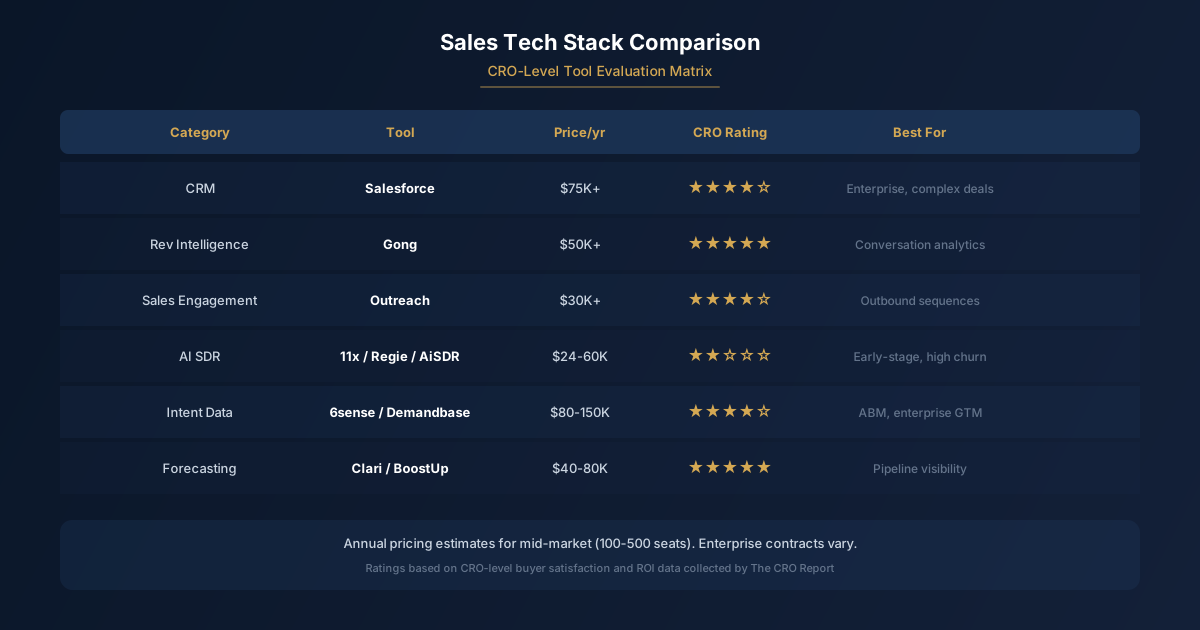
Artisan runs $1,500-2,000/month, which works out to an $18-24K/year commitment Related analysis. That price puts it in the serious-budget category. A team should buy it because it can replace software and work, not because Ava had a convincing demo.
The monthly number is only half the decision. An annual agreement changes the test. You are committing budget before you know whether the system can find the right people, write usable messages, stay inside your brand voice, and produce meetings your reps would have wanted anyway.
Artisan looks cheaper beside 11x, but it is not the cheap option in the category. AiSDR bills $900 per month quarterly, $2,700 every three months Related analysis. That shorter billing cadence gives a buyer more room to change course if the software misses.
| Product | Price | Contract | Standout trait |
|---|---|---|---|
| Artisan | $1,500-2,000/month | Annual commitment | Ava plus bundled contact data |
| 11x | n/a | Annual contracts reported | Higher-cost AI SDR option |
| AiSDR | $900 per month quarterly, $2,700 every three months | Quarterly billing | Lower-cost alternative |
The right comparison is not “which tool has the most polished AI story?” It is how much software, data spend, and manual prospecting work Artisan can remove from your current setup.
If Artisan replaces a data subscription and an outreach tool without lowering lead quality, the price becomes more reasonable. If it becomes another tab your team monitors while still paying for the old stack, it gets expensive fast.
For the direct competitor view, read our 11x review and AiSDR review. The products share a category label, but they ask buyers to take different financial and operational risks.
Ava is Artisan’s AI SDR assistant. In practical terms, it is meant to take on the front end of outbound work: finding prospects, researching them, preparing outreach, and running email campaigns.
Prospecting is the first job. Ava uses the platform’s included data to identify people and companies that fit your target market. That matters because a sequence is only as useful as the list behind it. Great email copy sent to the wrong buyers is still spam with better punctuation.
Lead research is where the product tries to earn its name as an AI SDR rather than a sequencing tool with an assistant attached. A useful system should turn public signals, company context, and role information into enough background for outreach to feel targeted. The important question is whether Ava’s research is specific enough to alter the message, or merely creates plausible filler around a job title.
Email outreach is the next layer. Ava can help prepare and send campaigns, which gives teams a way to cover more accounts without handing every first-touch task to an SDR. That can free reps to spend more time on replies, discovery, and deals already moving through the pipeline.
There is also a B2B chat context to consider. Sales leaders evaluating AI assistants want to know whether the software understands the account, the buyer, and the purpose of the conversation. A generic chatbot can produce clean sentences. An SDR needs to understand why this company is worth pursuing and what makes the recipient a credible contact.
Ask Artisan to show this live with your ICP. Give the team a real account list and ask Ava to explain why each account belongs there. Then read the proposed outreach without the salesperson narrating over it. The product should hold up when the room goes quiet.
You should also test the handoff. Ava may create interest, but someone on your team has to take the reply and turn it into a useful conversation. Can the rep see the research, message history, and account context without digging through a maze of generated notes? That determines whether AI-generated activity becomes pipeline or just another reporting metric.
Artisan bundles a 300M+ contact database into the subscription Related analysis. That is the core of the product’s appeal.
Most AI SDR vendors still require a separate source of prospect data. You may bring Apollo, ZoomInfo, or another database into the workflow, then connect it to enrichment and outreach tools. Each product has its own records, billing, rules, and failure points. Somebody ends up reconciling fields, cleaning lists, and explaining why the campaign used the wrong employee count.
Artisan puts the database inside the same environment Ava uses for prospecting and outreach. The promise is straightforward: identify a target, research them, build an audience, and launch outreach without moving records between several systems.
Consolidation can be a win. Fewer integrations mean fewer places for data to go stale. A smaller tool stack can also make ownership clearer. When a campaign underperforms, the team can inspect one workflow instead of opening several dashboards and blaming the sync.
There is a tradeoff. A bundled database only helps if its coverage and accuracy fit the market you sell into. A broad contact count sounds useful, but your business does not buy broad contact counts. It buys the ability to reach specific roles at companies that can pay for what you sell.
Run a data-quality test before signing. Pull a sample of accounts your team already knows, then compare titles, employment status, company details, and usable contact information against the system you trust today. Review the misses with the same seriousness as the hits. Bad records create bad outreach at scale.
The other tradeoff is dependency. A best-of-breed stack can be annoying, but it lets you replace one weak component without rebuilding everything. An all-in-one vendor asks you to trust its data, its outreach engine, and its AI assistant at the same time.
That can be worth it for a lean team that needs speed. It is harder to justify for a team with a strong data process and existing tools that already work. The question is whether Artisan removes enough operational drag to outweigh the control you give up.
An annual contract is a bigger ask when the technology is still maturing. AI SDR vendors are selling software that touches your market, your reputation, and your pipeline before a human on your team sees every interaction.
The category has already shown how quickly a flashy pitch can turn into customer frustration. Rival 11x has a reported 75% churn within 3 months on annual contracts Related analysis. That figure does not prove Artisan will follow the same path. It does show why annual terms deserve scrutiny across the category.
Ava may improve during your contract. It may also expose limits that only appear after the initial launch: weak data coverage in your segment, messages that flatten into the same cadence, poor reply handling, or a setup process that depends on more internal labor than the sales call suggested.
The contract changes who absorbs that uncertainty. Once you sign, the vendor has your annual commitment. Your team still has to make the software work.
Ask for a detailed definition of success before the agreement starts. What does the company count as a qualified meeting? Who approves the targeting and messaging? What happens when the system reaches prospects your sales team would exclude? How quickly can you pause campaigns if quality drops?
Get clear on the work required from your side as well. Someone must own target-account rules, messaging review, deliverability, reply routing, and feedback to the platform. AI can handle repetitive work, but it cannot decide what your sales team should value without inputs from the people who understand the market.
Request proof from customers with a similar buyer, sales motion, and deal size. A vendor can show strong results in a market where a broad outbound list works. That does not mean it will work for a narrower enterprise sale or a product that requires careful qualification.
Look closely at onboarding. The best case is a system that quickly learns your targeting and creates useful outbound activity. The bad case is paying for an annual product while your team spends months correcting it. A sophisticated demo cannot answer that question. A concrete implementation plan can.
Artisan is a stronger fit for sales leaders who want one vendor to cover prospect data and outbound execution. It is particularly appealing when the current workflow has become a pile of tools, manual exports, and unclear ownership.
It also suits teams that can actively manage the system. Ava should have a human owner who understands the ICP, can judge message quality, and has the authority to stop a campaign when it starts creating the wrong kind of activity.
The product is less attractive for teams that already have strong data coverage and a mature outbound process. In that situation, the bundled database may overlap with tools you have already paid to set up, while the annual agreement removes flexibility you currently enjoy.
A buyer who wants a smaller initial commitment should look at AiSDR review before signing. A buyer focused on how Artisan compares with another AI SDR approach should also read the Artisan vs Regie comparison.
Artisan has the right instinct. Data, research, prospecting, and outreach belong closer together than most sales stacks allow. Ava gets more useful when it can work from an included contact database instead of waiting for a separate tool to feed it lists.
The annual commitment is the problem. You are buying an operating model, not a feature. It needs to prove that its data fits your market, its research changes the message, and its outreach creates conversations worth handing to reps.
Proceed with cautious optimism. Artisan can simplify a fragmented outbound motion and costs less than 11x. The team that wins with it will be the one that treats implementation as a real sales process, not a software switch they can flip and forget.
For a broader category view, see our best AI SDR tools comparison. Can Artisan earn enough of your outbound stack before the annual contract turns a promising experiment into sunk cost?
The CRO Report delivers honest assessments of GTM tools from a practitioner perspective.
Subscribe to The CRO Report Browse All Tool Reviews