
An evidence-led 11x AI SDR review covering outreach automation, annual contract risk, reported churn, testimonial concerns, and buyer evaluation.
The review lists a $60K annual commitment for 11x. Related analysis The review lists a 12mo minimum contract. Related analysis That puts 11x AI SDR in a category where the buying decision matters more than the demo.
Our verdict remains critical. Initial outreach automation may save time at the top of the funnel, but it does not prove the system can handle replies, objections, or the handoff to a salesperson. Those are separate jobs. Treating them as one capability is how a revenue team signs a long contract for activity that never becomes pipeline.
The page reports 75% churn within 3 months. Related analysis That reported figure should change the evaluation process. A buyer needs evidence from their own market, their own data, and their own sales motion before accepting a long commitment.
An AI SDR is meant to take on work near the start of an outbound motion. That can include identifying target accounts, finding contacts, preparing outreach, and sending the first message. The pitch is easy to understand. Give the system a market, an offer, and a target customer. It starts conversations while your sales team focuses on calls and deals.
That pitch has limits. Finding an email address and sending an opener are structured tasks. A prospect reply is not. Someone may ask a technical question, challenge a claim, mention a competitor, request a different contact, or signal interest without offering a meeting. The quality of the next move determines whether the conversation becomes useful.
A human SDR can make a judgment call with incomplete information. They can spot that a reply came from the wrong person, recognize when a prospect is irritated, or pull in an account executive before the thread goes cold. An AI workflow needs to show how it handles those moments. Buyers should ask to see the full path from target account to qualified opportunity, not a polished opening sequence.
The distinction matters because outbound teams can create plenty of activity without creating revenue. Messages sent, contacts found, and meetings requested are easy metrics to display. Pipeline quality is harder. A team should know whether the system produces meetings that progress, whether those meetings fit the ideal customer profile, and whether the sales team trusts the conversations it receives.
The review says 11x has $50M+ in VC funding. Related analysis Funding may help a company build product, hire people, and stay visible. It does not answer whether the product can represent your company well in a live sales conversation.
For teams comparing outbound tools, Apollo vs Instantly is useful context when a $60K annual commitment is on the table. Related analysis The decision depends on whether an AI SDR can generate outreach. It is whether its work is better than the process you can build with software, clean data, and accountable people.
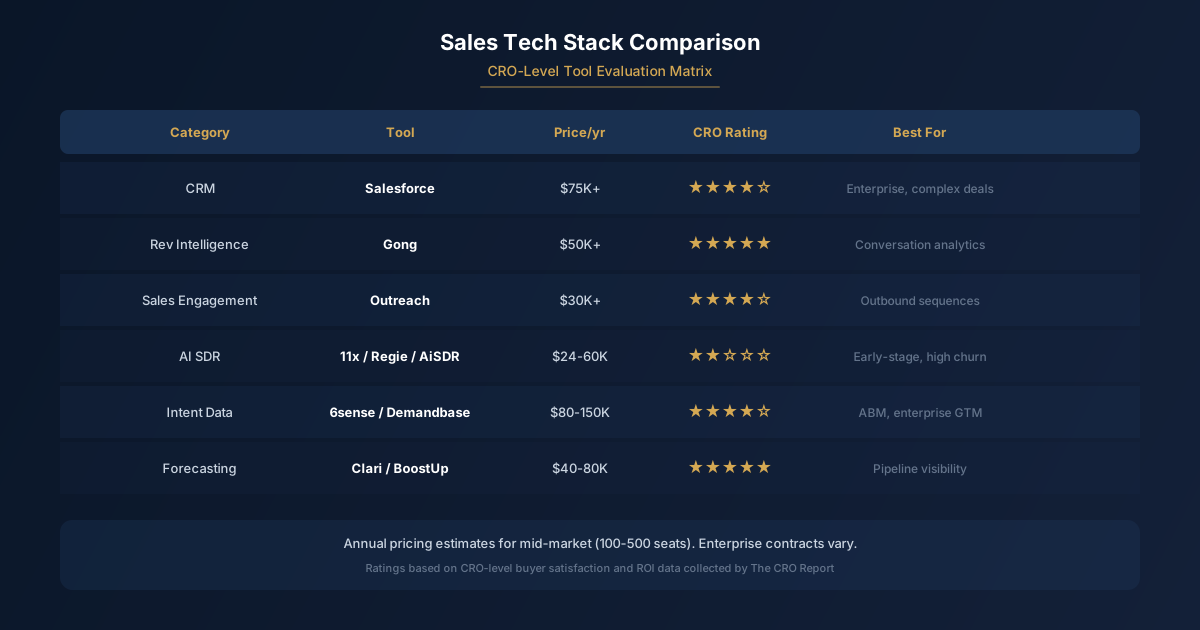
The review lists a $60K annual commitment for 11x. Related analysis The page lists $60,000 as the annual contract cost. Related analysis Buyers should read those terms as an operating commitment, not as a software line item.
An annual contract changes the burden of proof. A short experiment can tolerate some mess. A long commitment cannot. Before signing, a revenue leader should know what the system will do, what it will not do, who owns the output, and how success will be judged when the early novelty wears off.
The review lists a 12mo minimum contract. Related analysis Ask what happens if the system misses the market, the copy misses the audience, or the data produces low-quality conversations. Ask who is responsible for fixing the problem. A contract protects the vendor’s revenue. Your team still owns the quota.
A sensible evaluation should separate the roles involved in an outbound motion.
| Seniority tier | What to verify | Decision risk |
|---|---|---|
| Revenue leader | Pipeline quality and contract terms | Budget committed to weak meetings |
| Sales leader | Reply quality and handoff process | Reps inherit poor conversations |
| Operations leader | Data sources and reporting | Activity metrics hide poor fit |
| Frontline seller | Prospect experience | Brand damage from bad outreach |
This is where a lot of AI SDR evaluation gets slippery. The buyer sees a system send messages and assumes that the most difficult work has been solved. It has not. A company may still need people to review targeting, approve messaging, handle replies, qualify meetings, and repair relationships after poor outreach.
The page reports 75% churn within 3 months. Related analysis If that reported outcome reflects a broader customer pattern, the expensive part includes more than the contract. It is the time your team spends trying to make the tool work after it has already become a distraction.
Build the commercial review around evidence. What access will the vendor provide to activity data? Can you inspect reply threads? Can you see which accounts were approached? Can you separate meetings booked from opportunities created? Can you stop or change campaigns quickly when a message is failing?
Data quality deserves its own review. Data enrichment tools matter when the page lists $60,000 as the annual contract cost. Related analysis Poor data turns automated outreach into an expensive way to contact the wrong people.
TechCrunch reported concerns about fabricated customer testimonials connected to 11x. Buyers should read that reporting before signing a long agreement. A testimonial is supposed to reduce uncertainty. If its provenance is in question, it creates more uncertainty than it removes.
The review lists a $60K annual commitment for 11x. Related analysis That price raises the standard for proof. Buyers should expect clear references, direct access to customer evidence, and a candid explanation of what results depend on the buyer’s own market and internal sales process.
Published controversy does not tell you everything about a product. It does tell you to tighten the process. Ask for customers whose business resembles yours. Ask what they were trying to solve before they bought. Ask what work still sits with their internal team. Ask how they measure success after the initial launch period.
The page reports 75% churn within 3 months. Related analysis Churn can have many causes, but reported churn at that level should push a buyer toward harder questions. Were customers dissatisfied with lead quality? Did the product fail to work across different markets? Did teams expect autonomous selling when they had purchased outreach automation?
The critical issue is whether the vendor’s promise and the buyer’s operating reality line up. An AI SDR may be useful in a narrow, supervised workflow. A company looking for a replacement for sales judgment is buying something else entirely.
Good vendors will tolerate scrutiny. They should be able to explain where automation helps, where a human needs to intervene, and what conditions produce poor outcomes. If a sales process relies on vague claims, carefully selected screenshots, or references that cannot answer direct questions, walk away.
The page says 11x has $50M+ in VC funding. Related analysis Venture backing can create pressure to grow fast, sell a large vision, and close annual commitments. Your job is not to finance that ambition. Your job is to buy a system that improves your sales motion.
Start with the workflow. Ask the vendor to define the boundary between automated prospecting and human sales work. Who approves the account list? Who reviews the message? What happens when a prospect responds with a question? Who decides whether a reply is qualified? Where does the handoff happen?
Then ask for evidence from a campaign that resembles yours. The industry, sales cycle, target persona, and offer all matter. A system that performs well in a broad, high-volume market may be a poor fit for a company selling a complex service to a small group of senior buyers.
Ask to inspect the data rather than accepting summary metrics. You want the account list, the sequence logic, the messages, the reply threads, and the outcomes. A dashboard can make a weak campaign look busy. A sales leader needs to see whether the conversations are worth pursuing.
The review lists a 12mo minimum contract. Related analysis Ask what happens before the commitment is final. Can the vendor define a test with clear exit conditions? Can you measure account quality and reply quality before increasing volume? Can you change the campaign if your market rejects the message?
Salesloft vs Reply.io is another useful comparison when the review lists a $60K annual commitment for 11x. Related analysis The alternative may be a tool stack that gives your team more control over data, copy, and follow-up. That creates work, but it also makes the work visible.
A buyer should also ask whether their own team is prepared. AI outreach does not erase the need for a clear ideal customer profile, credible messaging, accurate data, and a sales team that can convert interest. It can amplify a disciplined outbound process. It can also amplify confusion at scale.
The question is simple: does the vendor help your team produce better conversations, or does it produce more conversations for your team to clean up?
The CRO Report delivers honest assessments of GTM tools from a practitioner perspective. No sponsored content. No affiliate-driven recommendations.
Subscribe to The CRO Report Browse All Tool Reviews