ZoomInfo vs Apollo comes down to enterprise data depth versus an all-in-one prospecting and outreach workflow, with different price and contract contexts.
ZoomInfo vs Apollo is a choice between buying an enterprise data provider and buying an all-in-one prospecting workflow. ZoomInfo is described at $15K to $50K per year, while Apollo is described at $49 per user per month. Those published prices point to two different buying motions, not a simple feature checklist.
A GTM leader can make either tool work. The better choice depends on where the friction sits today. If your team needs a major data vendor, intent context, and a system built around enterprise buying, ZoomInfo fits the conversation. If reps need to find prospects, enrich records, and run outreach from one place, Apollo has a cleaner pitch.
The mistake is treating this as a database bake-off. Data is only useful when your team can turn it into a useful account list, a timely message, and a pipeline conversation.
ZoomInfo suits teams buying enterprise data and intent capabilities. Apollo suits teams that want prospecting data, enrichment, and outreach in one workflow. ZoomInfo is described at $15K to $50K per year, while Apollo is described at $49 per user per month.
ZoomInfo and Apollo serve the same broad job: helping revenue teams identify people and companies worth contacting. They approach that job from different starting points.
ZoomInfo is positioned as an enterprise data provider. The buyer is often building a data foundation for a larger go-to-market operation, where account selection, contact records, and intent context sit upstream of several teams and systems. That usually means the tool is part of a wider sales and marketing stack.
Apollo packages data with the work that follows it. A rep can prospect, enrich a record, build a list, and run outreach without stitching together as many products. That is attractive when the immediate problem is activity and workflow discipline, rather than simply access to more data.
The published price context makes the split plain. ZoomInfo is described as $15K to $50K per year in the ZoomInfo vs Apollo comparison. Apollo is described as $49 per user per month in the same ZoomInfo vs Apollo comparison.
| Buying lens | ZoomInfo | Apollo |
|---|---|---|
| Core role | Enterprise data provider | All-in-one prospecting tool |
| Data workflow | Data and intent context for GTM teams | Prospecting data plus outreach |
| Outreach | Works alongside your sales workflow | Built into the product workflow |
| Enrichment | Supports data needs | Included alongside prospecting |
| Published price context | $15K to $50K per year | $49 per user per month |
| Best fit | Enterprise data buyer | Team seeking one prospecting workspace |
The table is deliberately simple. The important question is whether your team wants a data layer that feeds existing systems or one workspace where people can move from target account to outreach without leaving the product.
ZoomInfo has a listed price of $15,000 in its software offer data, according to the ZoomInfo vs Apollo comparison. That figure puts the product in a different budget conversation than a per-user prospecting tool.
There is also a useful market-read signal in the available review counts. ZoomInfo is listed with 8,400 reviews in the ZoomInfo vs Apollo comparison, while Apollo is listed with 7,200 reviews in the same ZoomInfo vs Apollo comparison. Neither count tells you which tool will fit your team. It does show that this is a mature comparison with buyers on both sides.
Start with the operating model, because it determines what your team will ask the software to do.
An enterprise data provider sits near the top of the funnel. Revenue operations may use it to shape account lists. Marketing may use it to decide where to focus campaigns. Sales leaders may want intent context before assigning accounts or changing coverage. Individual reps still use the data, but they are not the only customer inside the company.
That is the ZoomInfo case. You are buying data as infrastructure for a broader GTM motion. The tool has to support the way your teams already work, including the systems where records, campaigns, and sales activity live.
Apollo starts closer to the rep’s day. The product combines prospecting data, enrichment, and outreach. That changes the practical buying question. Instead of asking how data will feed several systems, ask whether your sellers can do enough of their prospecting work in one place.
That sounds like a small distinction until you look at adoption. A data product can be valuable and still create work. Someone has to define the ideal customer profile, build the lists, route records, keep fields useful, and make sure reps know what to do next. An all-in-one product can reduce handoffs when the team needs a tighter path from research to action.
The tradeoff is not philosophical. It is operational.
A larger organization may already have sales engagement software, a CRM process, marketing automation, and an operations team that owns data quality. In that environment, a dedicated enterprise data vendor has a natural home. It can support a more specialized stack without forcing everyone into a new outreach workflow.
A leaner sales organization may have the opposite problem. Reps may be bouncing between prospecting tabs, enrichment tools, spreadsheets, and messaging platforms. Apollo’s combined workflow is built for that buyer. Fewer product handoffs can make prospecting easier to run and easier to inspect.
The point is not that one model is universally better. It is that buying an enterprise data provider when your team needs an outbound workspace can produce a very expensive mismatch. Buying an all-in-one prospecting tool when operations needs a broader data foundation can create a different kind of frustration.
You can see the budget distinction in the published figures. ZoomInfo is described as $15K to $50K per year in the ZoomInfo vs Apollo comparison, while Apollo is described as $49 per user per month in that ZoomInfo vs Apollo comparison. The price tells you to ask different questions of each product.
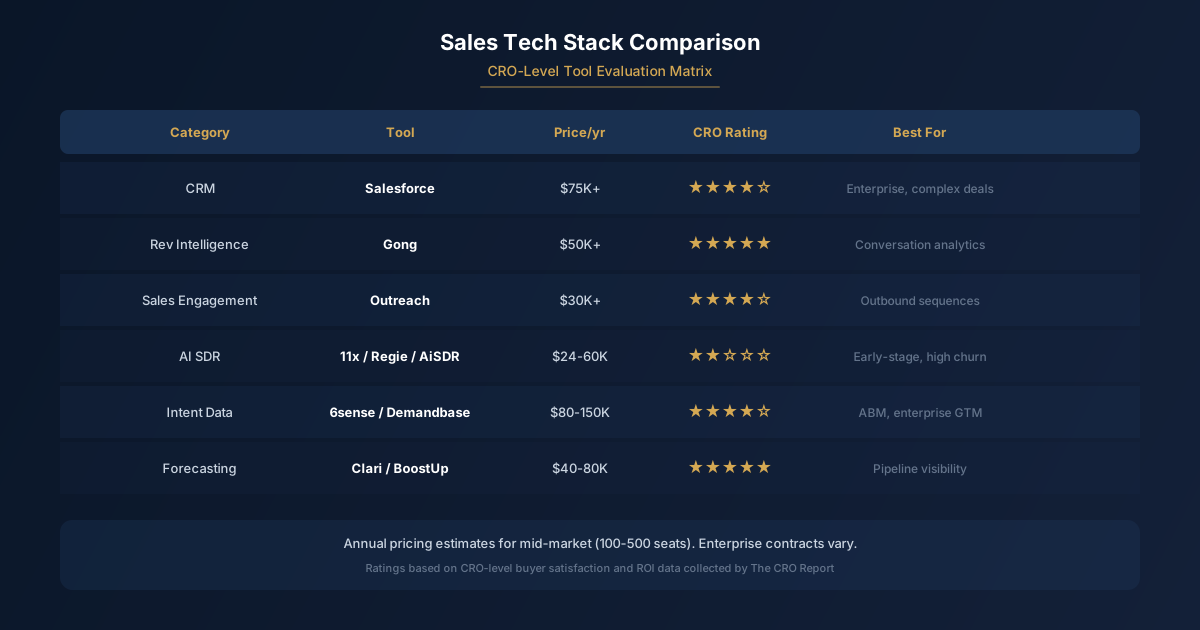
Pricing should shape the evaluation early, because it changes who needs to agree before the tool becomes useful.
ZoomInfo’s published context is enterprise-oriented. The page describes ZoomInfo as $15K to $50K per year, with $15,000 listed as a price in its software offer data. Both figures appear in the ZoomInfo vs Apollo comparison. That makes ZoomInfo a purchase that deserves a clear owner, a defined use case, and agreement across the teams that will depend on the data.
Apollo’s published context is $49 per user per month, according to the ZoomInfo vs Apollo comparison. A per-user model makes it easier to connect spend to the people expected to prospect and run outreach. It also puts more pressure on adoption. If the workflow does not become part of a rep’s day, the product can become another login with a billing line.
Do not reduce this to sticker price. The cost of a data provider sits alongside the systems and people required to make use of it. The cost of an all-in-one workflow sits alongside the question of whether it can become the place where sellers actually do their work.
A good buying process asks who owns each step after the contract is signed. Who defines target accounts? Who enriches records? Who decides which signals change outreach? Who watches whether new data improves meetings and pipeline? If no one owns those answers, the tool choice will not solve the underlying problem.
GTM leaders should also separate data needs from outreach needs. If the team already has a sales engagement system it likes, a combined platform may duplicate part of the stack. If outreach is scattered or inconsistently executed, Apollo’s combined approach may be the point.
The same issue appears when comparing adjacent tools. Apollo is described as $49 per user per month in the ZoomInfo vs Apollo comparison, while teams evaluating outreach software can also review sales engagement platforms. The data and engagement layers should work together, but they do not have to come from the same vendor.
ZoomInfo is described as $15K to $50K per year in the ZoomInfo vs Apollo comparison, and teams comparing enrichment workflows may also want to read Clay pricing. The important part is understanding where each product sits in the workflow before you compare spend.
ZoomInfo fits the buyer who needs enterprise data capabilities to support a broader GTM machine.
That buyer often has several stakeholders. Sales needs contacts and account research. Marketing wants audience inputs. Revenue operations needs a dependable process around records and account selection. Leadership wants intent context to inform where the team spends time. The product is part of a larger system, and the evaluation should include the people who run that system.
Apollo fits the buyer who wants prospecting, enrichment, and outreach together.
That buyer may be building outbound motion from the ground up, cleaning up a fragmented workflow, or giving sellers a more direct route from list building to messaging. The product has a stronger case when the same people who find prospects are also responsible for contacting them.
The distinction is easiest to see by seniority tier.
| Seniority tier | ZoomInfo fit | Apollo fit |
|---|---|---|
| GTM leader | Needs enterprise data and intent context across teams | Needs one place for prospecting and outreach |
| Revenue operations leader | Owns data processes across the stack | Wants a simpler rep workflow with data included |
| Sales leader | Uses data to guide account focus and coverage | Wants reps prospecting and messaging in one product |
| Individual seller | Uses data within an established GTM system | Wants a direct workspace for list building and outreach |
| Procurement stakeholder | Evaluates enterprise data budget and terms | Evaluates per-user workflow spend |
The table should not become a rigid rule. A large company can choose Apollo for a specific outbound team. A smaller company can choose ZoomInfo when its data needs justify an enterprise vendor. The useful distinction is where the center of gravity sits.
Choose ZoomInfo when data depth, intent capabilities, and a wider GTM system are the priority. The tool is positioned for a buyer who sees data as a shared resource across the organization.
Choose Apollo when the immediate priority is getting from prospect discovery to outreach inside one product. The combined workflow is the appeal. Your reps do not need a separate explanation of how data becomes activity because the product puts those jobs close together.
Both tools can help a sales team find people to contact. The more useful question is what happens after the contact appears in front of a rep. Does the record feed a larger data and intent workflow, or does it need to become an outreach task right away?
That is the decision behind ZoomInfo vs Apollo. One buyer is assembling a GTM data foundation. The other is trying to give a prospecting team fewer places to work.
The CRO Report delivers weekly market intelligence for VP Sales and CRO-level executives.
Subscribe to The CRO Report Browse All Tool Reviews