

Demandbase Pricing: Costs, Contracts, and Fit
Demandbase pricing starts at enterprise contract levels. See expected costs, platform scope, and whether your ABM team has the operating model to use it.
Demandbase pricing starts at an enterprise level: entry contracts are listed at $50,000 to $75,000 per year. Related analysis That price makes sense for companies with a serious account-based motion, an established demand team, and enough pipeline value inside a target-account list to justify the work.
Demandbase can coordinate advertising, intent, account identification, web experiences, sales intelligence, and buying-group activity from one system. That scope is useful when your team has outgrown a collection of point tools and needs everyone working from the same account view.
It can also become an expensive piece of shelfware. A unified platform does not fix weak account selection, unclear ownership between sales and marketing, or a team without someone accountable for operating it.
Key Takeaways
- Demandbase uses custom enterprise contracts rather than public self-serve plans.
- The platform combines intent, advertising, account intelligence, and buying-group work.
- Price depends on modules, data access, activation scope, and implementation needs.
- Enterprise teams with mature ABM operations are the best fit.
- Smaller teams should compare lighter tools before taking on a full-platform contract.
Demandbase Pricing and Contract Scope
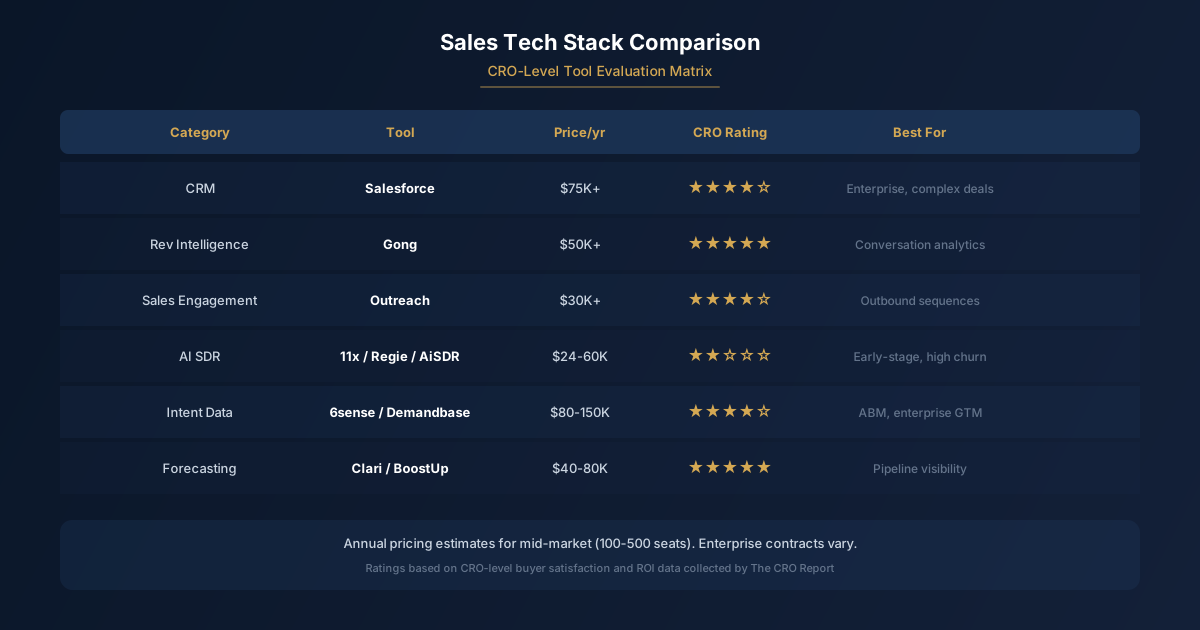
The decision depends on whether Demandbase has enough features. It does. The question is whether your team can turn those features into a coordinated account-based program.
Demandbase pricing is custom, which means the contract usually reflects the modules you buy, the size and shape of your addressable market, the data and activation scope, and the support required to get the system working across your revenue organization. Entry-level pricing is listed at $50,000 to $75,000 per year. Related analysis
That range is a meaningful filter. It rules out teams that are still proving whether account-based marketing works for them. It also forces a more honest conversation about the cost beyond the contract itself: implementation time, campaign production, data hygiene, CRM ownership, sales adoption, and the people who will translate account insight into action.
Full-platform pricing is listed at $150,000 to $200,000+ per year. Related analysis At that level, Demandbase should be evaluated as revenue infrastructure. You are paying for a system that can influence how marketing selects accounts, how advertising reaches buying committees, how sales prioritizes outreach, and how leadership judges account progress.
A lower entry contract can make sense if you have one sharp use case. Maybe you need better account identification on the website. Maybe paid media is already a large part of your pipeline motion and you want a purpose-built business-to-business DSP. Maybe sales needs a more useful account-prioritization layer.
The larger contract only makes sense when those use cases connect. Buying the full suite without a shared operating model is how companies end up with impressive dashboards and the same old handoffs.
| Contract scope | Likely fit | What you are buying |
|---|---|---|
| Entry range | ABM teams proving a focused account motion | A narrower set of modules and a defined activation use case |
| Mid-tier contract | Established demand teams expanding account programs | Broader data, advertising, and orchestration coverage |
| Full-platform contract | Enterprise revenue organizations | A unified account-based system across marketing and sales |
Demandbase was founded in 2006 and has raised $320M in total funding. Related analysis That history helps explain the platform’s breadth. It was built for a market where large business-to-business organizations want more than lead scoring and retargeting.
The review cites a $175M Series H. Related analysis Revenue exceeded $200M in 2024. Related analysis Those figures support the view that Demandbase is operating at enterprise scale, with an enterprise cost structure to match.
What Demandbase One Covers
Demandbase One is an account-based go-to-market platform. It brings together account identification, intent data, advertising, sales intelligence, and orchestration around a shared account record.
That matters because enterprise buying rarely follows a clean lead path. A visitor lands on the site anonymously. Another person from the same company reads a comparison page. A third person shows interest through research activity elsewhere. Sales may have an opportunity open already, or no record at all.
A conventional lead funnel often treats those as separate events. Demandbase tries to connect them to the account and the buying group behind it.
Intent signals and account prioritization
Intent is useful when it changes what a team does next. Demandbase combines first-party engagement with broader intent signals to help teams identify accounts that are researching a category, returning to key pages, or showing signs of movement.
The quality of that output depends on the inputs. A broad target-account list produces broad alerts. Weak CRM data produces weak account matching. If marketing and sales disagree on what a qualified account looks like, the platform will expose that disagreement faster than it solves it.
The better use case is specific: identify the accounts your team already cares about, define the behaviors that suggest active evaluation, and attach a clear play to each condition. Marketing can change media exposure or website experiences. Sales can prioritize outreach. Leaders can inspect whether account activity is moving toward meetings and opportunities.
That is why implementation scope matters. The technology can surface activity. Your team still needs to decide which activity deserves attention.
The business-to-business DSP
Demandbase has a native business-to-business DSP for account-based advertising. That gives teams a way to run advertising against target accounts without stitching together account data, audience workflows, and reporting from several vendors.
The practical benefit is coordination. If an account is in an early research stage, advertising can build familiarity while marketing delivers relevant content. If the account moves into an active evaluation stage, the message can change. If sales is working an opportunity, advertising can support the deal rather than operate in a separate universe.
This only works when campaign strategy is disciplined. Advertising to a list of companies is easy. Deciding which roles need which message, when to suppress existing customers, and how to measure influence without claiming credit for every deal takes more work.
Demandbase is strongest when advertising is part of a broader account plan. It is weaker when the buyer wants a plug-in demand-generation machine that runs itself. No platform has solved that problem. A larger media budget does not make the account strategy less vague.
Buying-group analysis
Buying-group analysis is one of the more important parts of the platform for enterprise teams. Deals often stall because the visible contact is only one part of the decision. A champion can be engaged while finance, security, operations, or an executive sponsor remain untouched.
Demandbase helps teams look at engagement across the account and identify gaps in the buying group. That can give sales and marketing a more useful view than a single contact score.
The key word is “useful.” A buying-group report is only valuable if it changes account action. If a critical function is absent, the team needs a plan to reach it. If engagement clusters around a lower-level user group, sales needs to know whether that is progress or a sign that the deal lacks executive support.
This is where Demandbase can earn its price. It gives a large team a common language for account health, instead of every function carrying its own spreadsheet and theory about what is happening.
Sales intelligence and orchestration
Demandbase also supports sales intelligence and account-stage orchestration. Marketing can use account behavior to decide where to spend attention. Sales can use the same account context to prioritize outreach. Website experiences and messaging can reflect where an account appears to be in the journey.
The temptation is to automate every step. Resist it.
Enterprise account-based work needs judgment. A high-value account may deserve a bespoke play. A strategic account with low activity may need research rather than another generic sequence. Some accounts should be excluded because the timing is wrong, the fit is weak, or a customer relationship makes outreach inappropriate.
The platform gives your team more inputs. It does not replace the people who know how to interpret them.
Who Should Consider Demandbase
Demandbase is a good fit for enterprise business-to-business organizations with a defined target-account strategy and enough coordination problems to justify a unified platform.
You should consider it if your marketing team runs account-based advertising, sales needs better account context, and leadership wants a clearer view of account progression across the funnel. It also fits teams where several people influence the same deal and where account-level measurement is more useful than a pile of individual lead metrics.
Revenue exceeded $200M in 2024. Related analysis That scale matches the buyer it tends to serve: larger organizations willing to make a platform decision, fund implementation, and assign ownership after the contract is signed.
The best internal buyer is usually not one person. Demand generation may own campaign execution. Operations may own data and integrations. Sales leadership needs to agree on account priorities and follow-up. An executive sponsor needs to decide which revenue metric makes the investment worth it.
| Seniority tier | Main question | Demandbase fit |
|---|---|---|
| Revenue leader | Will account programs improve pipeline quality and deal progression? | Strong when account-level reporting guides operating decisions |
| Marketing leader | Can campaigns, web activity, and intent work from one account view? | Strong when ABM is a core motion |
| Operations leader | Can the data model and workflows support the platform? | Strong when CRM governance is established |
| Sales leader | Will reps get actionable account context? | Strong when sales agrees to work named-account plays |
| Small-team founder | Can one person run this and see quick payback? | Usually a poor fit |
Demandbase has raised $320M in total funding, including a $175M Series H cited in the review. Related analysis Related analysis That backing gave the company room to build a broad platform. It does not make the platform appropriate for every company that wants better outbound or more website intelligence.
A poor fit looks familiar. The company has no stable account list. Sales and marketing use different definitions of a target account. There is no one who can own implementation. Paid media is small or experimental. The buyer hopes intent data will create demand where the product and message have not yet found traction.
In those cases, the contract can become an expensive way to discover foundational problems. Fix the motion first. Then decide whether the team needs a unified system.
Demandbase Alternatives for Smaller Teams
Smaller teams should not buy a larger platform simply because their market uses the language of ABM. The right tool is the one your team can operate well enough to create pipeline.
Demandbase entry pricing is listed at $50,000 to $75,000 per year, while our Warmly review covers a lighter path for teams that want to focus on website visitor identification and outbound action. Related analysis That kind of comparison should start with the workflow, not the feature checklist.
If your immediate problem is knowing which companies visit the site and getting that information to sales quickly, a focused visitor-intelligence tool may be enough. If the problem is running account-based advertising, managing intent, measuring buying-group engagement, and coordinating marketing with sales at enterprise scale, Demandbase has a stronger case.
Full-platform pricing is listed at $150,000 to $200,000+ per year, and our Demandbase alternatives page is a useful starting point for teams comparing more focused options. Related analysis You are not looking for a cheaper version of the same product. You are looking for the smallest system that can support the motion you have today.
There is a practical middle ground for many companies: build a narrow account program, prove that the sales team acts on account signals, and expand the stack when the process becomes hard to manage manually. That sequence creates evidence before a major contract decision.
Demandbase is built for the point where the account motion is already working and fragmentation has become the problem. It is less useful when the motion itself is still a hypothesis.
Demandbase was founded in 2006, and GTM tools and reviews can help you compare the broader category before committing to an enterprise platform. Related analysis The contract decision should follow a clear answer to one question: does your team need a shared system for accounts, or does it need a simpler way to execute the next useful play?
The Purchase Decision
Demandbase is a serious platform for serious account-based programs. Its appeal comes from the combination of account intelligence, intent, advertising, buying-group analysis, and sales context in one place.
The price is the warning label. Entry-level pricing is listed at $50,000 to $75,000 per year, while full-platform pricing is listed at $150,000 to $200,000+ per year. Related analysis Related analysis A company should be able to explain how account-level execution will create enough pipeline, accelerate enough opportunities, or protect enough revenue to justify that spend.
Demandbase wins when the organization already has the people, data, and operating discipline to use it. The platform can make a mature ABM program more coordinated and easier to inspect.
Can your team name the account actions it would take differently next week if it had better intent, buying-group, and advertising data?
Sources
Want More Tool Reviews?
The CRO Report delivers honest assessments of GTM tools from a practitioner perspective.
Subscribe to The CRO Report Browse All Tool Reviews