Clay vs Apollo for GTM teams comparing data enrichment depth, prospecting coverage, pricing, workflow investment, and buyer fit.
Clay vs Apollo starts with a useful contrast: Clay lists 100+ providers for enrichment, while Apollo lists 275M+ contacts for prospecting. Related analysis
That contrast tells you what each product is built to do. Clay gives GTM operators a configurable data layer. Apollo puts prospecting and outreach in one place. If your team needs to assemble, enrich, score, and route data around an existing stack, Clay has the stronger case. If your team needs a place to find people and start outreach without building much around it, Apollo is the simpler purchase.
The bad comparison treats them as interchangeable databases. They are competing for part of the same budget, sure. But the operating model is different.
Clay asks your team to make decisions about sources, enrichment logic, and workflow design. Apollo gives your team a more opinionated path from contact discovery to outbound activity. That difference affects who gets value, how quickly they get it, and whether the tool becomes central to the GTM system or just another tab open during prospecting.
Clay fits teams that want 100+ providers and control over enrichment logic. Apollo fits teams that want 275M+ contacts alongside prospecting and outreach. Pick Clay for data-layer depth. Pick Apollo when an all-in-one workflow matters more than configuration.
Clay and Apollo overlap at the point where a GTM team needs better prospect data. The overlap ends quickly after that.
Clay is for teams that view prospect data as an input they need to shape. A record may need information from multiple sources, custom qualification, enrichment steps, and a destination in another system. The workflow is part of the product. The person operating it has more room to make judgment calls.
Apollo is for teams that want to identify prospects and act on them in the same environment. Its value comes from reducing handoffs. The list, the contact record, and the outreach motion sit closer together. That can be a cleaner setup for a sales team that needs momentum more than a configurable data layer.
| Decision area | Clay | Apollo |
|---|---|---|
| Core job | Configurable enrichment and data workflows | Prospecting and outreach |
| Coverage framing | 100+ providers | 275M+ contacts |
| Operating model | Build around the data layer | Use an all-in-one workflow |
| Starting price framing | $149/mo | $49/user/mo |
| Best fit | GTM operators with defined data requirements | Prospecting teams that value simplicity |
| Seniority fit | RevOps and growth leaders | Sales leaders and individual sellers |
| Outreach | n/a | Included in the broader workflow |
The table looks straightforward. The decision usually is not.
A lean outbound team can buy Apollo and start using it with little debate. A more developed GTM team may already have a CRM, sequencing tool, automation layer, and firm views on how records should be enriched. That team is not shopping for another all-in-one workspace. It is shopping for better raw material.
Clay wins when the quality and structure of that raw material determines whether the rest of the motion works.
Apollo wins when the team wants fewer systems between “find a prospect” and “contact a prospect.”
Clay’s 100+ providers are the central fact in this comparison. Related analysis A broad provider set gives an operator options when a particular data point is missing, weak, or poorly suited to a target segment.
That matters because enrichment is rarely a single-field problem. A GTM team may need company information, person-level details, signals, or research inputs that do not arrive cleanly from one source. The work is primarily about deciding how a record should be completed before it moves into a campaign or sales workflow.
Clay’s appeal is that it lets the operator own that process. The team can decide what counts as a usable record, where information should come from, and what should happen after enrichment. That creates more responsibility. It also creates more room to build an advantage that is specific to the team’s market.
Apollo’s 275M+ contacts point to a different kind of value. Related analysis The product is designed to put a large prospecting universe in front of the people who need to work it. For many outbound teams, that is the job. They want to identify accounts, find relevant contacts, and begin an outreach motion without turning data enrichment into its own operating discipline.
There is no abstract winner here. The winner depends on where the friction is.
If your team already knows who it wants to reach but keeps losing time to incomplete records, inconsistent inputs, and manual research, Clay is closer to the problem. It gives you a place to treat data quality as a workflow.
If your team lacks a practical way to build and work prospect lists, Apollo is closer to the problem. Its contact coverage and all-in-one structure remove the need to stitch together a starting point.
The difference becomes sharper as your targeting gets more specific. Broad prospecting can tolerate more standardization. Narrow account lists, unusual qualification rules, and research-heavy campaigns tend to expose gaps in a one-size-fits-all record.
Clay gives the operator more knobs to turn. That can be productive, or it can become a project with no owner. Teams should be honest about which version they are likely to create.
A strong RevOps or growth operator can turn Clay’s flexibility into a repeatable system. A sales team without that operating capacity may find Apollo easier to adopt because fewer choices are required up front.
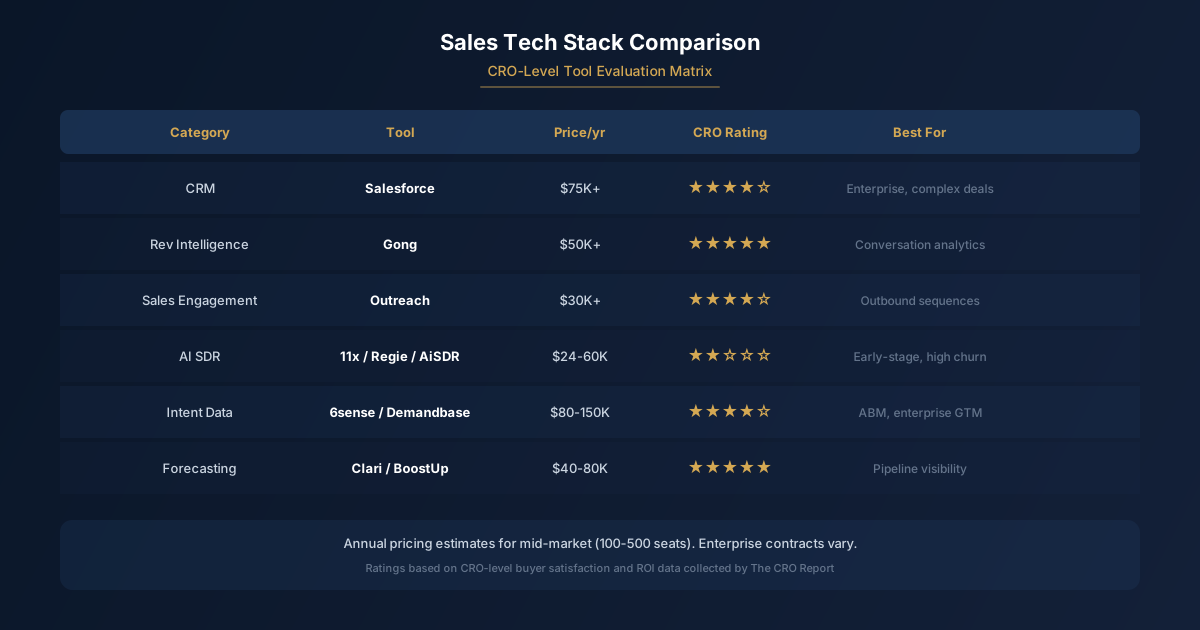
The current comparison lists Clay at $149/mo and Apollo at $49/user/mo. Related analysis Those figures should guide the evaluation, but they should not end it.
Pricing models reveal how a product expects to be used. Clay’s monthly starting point fits a shared data-layer mindset. The product is likely to be managed by someone building workflows for a broader GTM motion. The question is whether that shared capability will produce enough useful output to justify the operational attention it needs.
Apollo’s per-user framing fits a prospecting tool that can be handed to people doing outbound work. The cost discussion becomes more familiar: who needs access, what work happens inside the platform, and whether the team can consolidate enough activity to make the seat worthwhile.
That is why comparing the two products by price alone creates a false answer. A low-friction seat purchase can be expensive if it produces mediocre targeting. A configurable data layer can be expensive if no one builds and maintains the workflows that make it valuable.
The operating model matters more than the first invoice.
Clay requires a person who can define the desired output. What makes an account worth pursuing? Which fields need to be present? What should happen when the data is incomplete? Where should a finished record go? Those questions exist in every GTM organization. Clay puts them on the table.
Apollo lets teams defer more of that design work. The product’s appeal is that prospecting and outreach live together. A seller can work from a database toward action without waiting for a separate data project to become operational.
Neither approach is universally better. Companies often buy the wrong one because they mistake ease of purchase for fit.
A founder-led sales motion may prefer Apollo because the immediate job is building a list and starting conversations. A growth team supporting several segments may prefer Clay because the immediate job is constructing cleaner records and pushing them into a larger system.
The funding figures on the current page also show the scale behind the category: $3.1B and $1.6B. Related analysis Buyers should treat those figures as context, not a shortcut. A large company can still be a poor match for the workflow you need next quarter.
Choose Clay when your team has a specific data problem and someone who can own the solution.
That might mean your CRM records need deeper enrichment before routing. It might mean account research takes too long. It might mean your outbound motion depends on qualification logic that a standard prospecting workflow cannot express cleanly. In those cases, Clay’s configurable approach is the point.
Clay is also a sensible choice for teams that already have pieces of the GTM stack in place. If you have a CRM, a sequencing tool, and a clear workflow for outreach, adding another all-in-one product can create overlap. A flexible data layer may add more value because it improves the inputs going into the systems you already use.
The right Clay buyer is comfortable with ownership. Someone needs to decide how enrichment works, audit results, and keep the workflow aligned with the sales motion. Without that person, flexibility turns into unused capability.
Choose Apollo when the team needs a straightforward route from prospect discovery to outreach.
That often includes smaller sales teams, new outbound motions, or teams where individual sellers need to source their own opportunities. Apollo’s 275M+ contacts are useful when the immediate challenge is finding people to contact and giving the team a single place to work from. Related analysis
Apollo also fits teams that do not want to make data operations a separate project. There is value in a product that gets sellers moving without requiring a detailed enrichment design before anyone can begin.
The tradeoff is that simplicity gives you fewer opportunities to tailor the underlying data system around a particular market. That may be fine. Many teams do not need a highly customized enrichment workflow to hit their goals. They need a reliable prospecting motion that the team will use.
For a GTM leader, the practical decision comes down to who owns the work after the contract is signed.
If the answer is a RevOps manager, growth operator, or someone responsible for data quality across the funnel, Clay has the more natural home. If the answer is a sales leader trying to give reps a consistent outbound workspace, Apollo has the cleaner story.
Start with the workflow that breaks today.
Do not begin with feature lists. Begin with the point where work slows down, records become unreliable, or sellers lose context. A comparison only helps if it maps to an actual constraint.
If your team spends time gathering data from different places, checking whether records meet your standards, and preparing information for other systems, evaluate Clay around that workflow. Define a small set of records that represent the work you do most often. Ask whether the team can build the enrichment process it needs, understand the output, and keep it maintained.
If sellers spend time bouncing among a database, a spreadsheet, and an outreach tool, evaluate Apollo around the seller workflow. Ask whether the contact data, prospecting experience, and outreach flow reduce the handoffs your team deals with now.
The most useful evaluation criteria are operational.
Can the team explain what a good prospect record looks like? Can someone own the workflow after setup? Will sellers work inside the system rather than exporting data back into old habits? Does the product improve the part of the motion that is costing time or hurting quality?
Those questions cut through the category language quickly.
Clay is not a replacement for a team that has not defined its data requirements. Apollo is not a fix for a team that needs custom enrichment logic but has no plan for how it will use the resulting records. Tools amplify the operating model already present.
The same is true when comparing vendor pages. Read the Clay overview alongside the 100+ providers figure, then look at Apollo alongside its 275M+ contacts figure. Related analysis You are looking for the product that fits the work your team will repeat, not the product with the longest list of capabilities.
Teams also change. A company that starts with Apollo may later need more control over enrichment as targeting becomes more demanding. A company that builds deeply in Clay may still need a simpler prospecting workflow for a new sales team. The tools can sit near each other in a stack, but that does not make them substitutes for every buyer.
The cleaner purchase is the one that matches your next operating constraint.
Clay is the better choice when data-layer depth is the constraint. Apollo is the better choice when all-in-one prospecting and outreach are the constraint. That is the comparison.
For more options around the prospecting side of the decision, the Apollo alternatives guide uses the same $49/user/mo starting point as a reference. Related analysis The harder question is whether your team needs another place to prospect or a better way to construct the data that feeds every downstream tool.
The CRO Report delivers weekly market intelligence for VP Sales and CRO-level executives.
Subscribe to The CRO Report Browse All Tool Reviews