
11x vs Artisan for AI SDR Buyers
11x vs Artisan compares reported costs, contract risk, reply handling, and the proof sales leaders should demand before buying an AI SDR.
(Per User Reports)
Monthly Cost
3-Month Churn
Emails (Artisan User)
11x vs Artisan starts with a cost gap that should change how you evaluate both products. The page reports $5K+ as 11x monthly cost Related analysis. It reports $1.5K as Artisan starting monthly cost Related analysis.
That gap does not settle the purchase. It tells you where the burden of proof sits.
Both companies sell the idea that software can take outbound work off your team’s plate. That promise is attractive when pipeline goals rise, hiring gets expensive, and your existing reps already have too much to do. It also creates a familiar procurement mistake: a buyer watches a polished demo, hears about automated prospecting, and signs before checking whether the system can produce replies worth handing to sales.
An AI SDR is software that researches prospects, drafts outreach, sends messages, and may help manage replies. The useful definition is narrower than the marketing version. It is an outbound production system that still needs a credible market, good data, clear messaging, and someone accountable for the conversations it creates.
The page lists $60K for 11x annual commitment Related analysis. A commitment at that level turns a software evaluation into a serious operating bet. You are not buying a clever prospecting feature. You are deciding whether an outside system gets to shape a meaningful part of your market contact strategy for an extended period.
Artisan may look like the easier entry point. 11x may look like the more detailed answer. Neither description tells you whether it can reach your buyers, earn attention, and create conversations your account executives will want to own.
TLDR
11x vs Artisan comes down to reported cost, contract exposure, and whether either system can create useful replies in your market. 11x asks for a larger commitment. Artisan starts lower, but reported outreach results have been uneven. Run a proof-heavy evaluation before signing.
Key Takeaways
- The reported $5K+ 11x monthly cost and $60K annual commitment create a much larger downside if outbound results disappoint.
- Artisan’s reported $1.5K starting monthly cost lowers the entry point, not the need to validate reply quality.
- A reported Artisan user outcome of 0 replies after 1,400 emails should make reply handling part of the buying process.
- High-volume outreach is the clearest plausible use case, provided the reachable market is large and message quality holds up.
- Ask for evidence from a live workflow, not a generic product demonstration.
11x vs Artisan Cost and Contract Signals
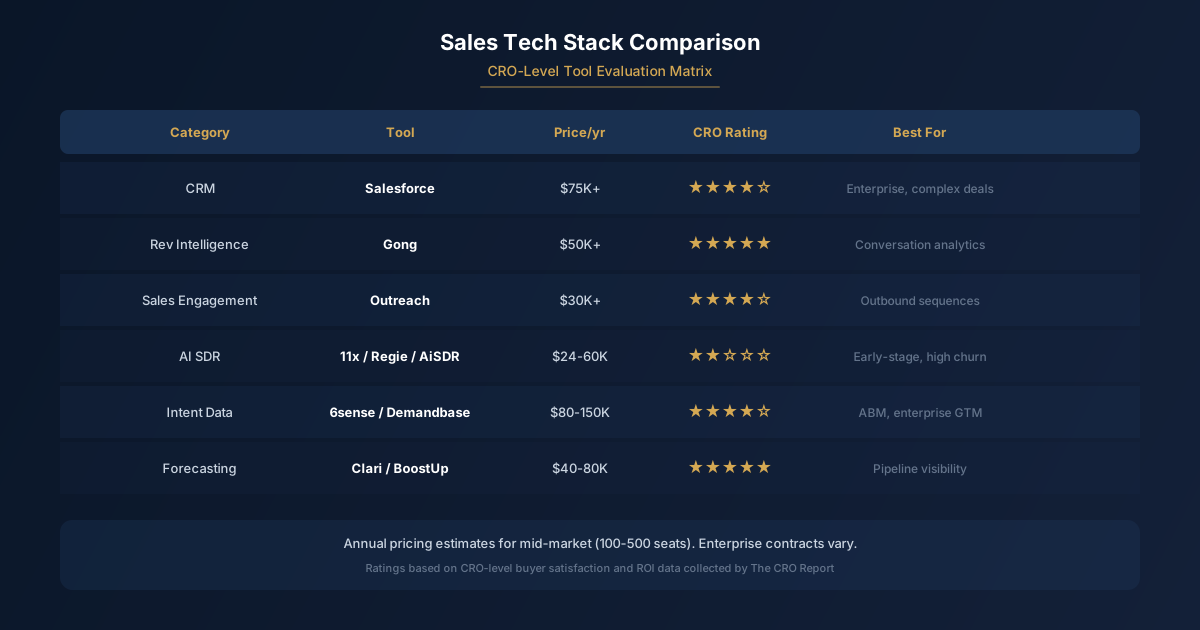
The reported $5K+ as 11x monthly cost puts 11x in a different buying category from a lightweight sales tool Related analysis. A sales leader considering that level of spend should focus on what has to be true for the economics to work.
A meaningful outbound program needs more than email volume. It needs a market with enough reachable accounts, contacts whose roles are identifiable, an offer that gives strangers a reason to respond, and a sales team that can move quickly when interest appears. If any part of that chain is weak, automation only helps you find the weakness faster.
The reported $1.5K as Artisan starting monthly cost creates a lower-friction path to trying the category Related analysis. That can be useful for a team that wants to learn whether AI-assisted outreach belongs in its motion. Lower cost does not turn a weak outbound thesis into a good one.
The contract matters as much as the starting price. The page lists $60K for 11x annual commitment Related analysis. When a vendor asks for that kind of commitment in a young category, the buyer should ask what happens if the initial audience, copy, or deliverability assumptions prove wrong.
Annual terms tend to protect the vendor from a disappointing early result. They can also make internal honesty harder. Once a team has committed budget, nobody wants to be the person who says the tool created activity without qualified opportunity. That is how mediocre programs linger.
The reported 75% 11x churn within 3 months is the kind of claim that should send a buyer into verification mode Related analysis. It does not prove every customer had the same experience. It does mean you should ask direct questions about retention, implementation, account support, and what the vendor considers a successful launch.
| Buying factor | 11x | Artisan | What to verify |
|---|---|---|---|
| Reported starting cost | $5K+ monthly | $1.5K monthly | What is included in the commercial scope |
| Reported contract exposure | $60K annual commitment | n/a | Exit terms if the program fails to create useful pipeline |
| Reported customer outcome | 75% churn within 3 months | 0 replies after 1,400 emails | Whether the vendor can provide comparable customer evidence |
| Best potential fit | Broad outbound motion with a large market | A lower-cost category test | Whether your buyers are reachable at meaningful volume |
| Main buying risk | Commitment before proof | Cheap activity mistaken for progress | Reply quality, qualification, and handoff |
The table should not make this look more precise than it is. These are reported signals, not a forecast for your company. Your market can be better or worse than the examples. Your offer can be sharper. Your data can be a mess. That is why the evaluation has to be designed around evidence you can inspect.
Teams shopping for broader AI SDR research should compare the reported $5K+ 11x monthly cost against the cost of fixing their own data, targeting, and messaging first. A platform cannot compensate for a market definition that nobody on the revenue team agrees on.
Reply Handling and Outreach Volume
Reply handling is where many AI SDR evaluations get vague. Vendors can show prospect lists, personalize a few messages, and demonstrate automated sending. The harder question is what happens after a prospect responds.
A useful reply is more than a positive-looking message. It should have enough context to determine whether the account fits, whether the person has the right role, whether timing is plausible, and whether a human rep can advance the conversation without restarting from scratch. Sales teams feel the difference immediately.
The comparison cites an Artisan user report describing 0 replies after 1,400 emails Related analysis. One report is not a complete verdict on a company. It is a useful warning against evaluating a product by send volume, dashboard activity, or how natural an isolated sample message sounds.
High-volume outreach is the most plausible fit for either option when your market is broad enough to support it. A company with a large addressable audience, repeated buyer profiles, and a simple initial offer has more room to absorb imperfect targeting. A narrow market has no such cushion. Poor messages travel fast when everyone knows everyone.
The reported 75% 11x churn within 3 months makes high-volume usage a question of operational discipline, not vendor ambition Related analysis. If the platform sends at scale before your team has approved targeting and copy, you may burn through the part of the market you most need to protect.
There is a reason experienced outbound operators obsess over replies rather than sends. Replies expose the quality of the whole motion. They tell you whether your list is pointed at the right people, whether the offer creates curiosity, whether the timing makes sense, and whether prospects think the message deserves a human response.
Use a staged evaluation that forces each part of the workflow into the open:
- Start with a defined slice of your addressable market. Choose accounts your sales team already understands well enough to judge whether the targeting is credible.
- Review the prospect data and messages before broad sending. Look for factual errors, generic claims, and language that sounds unlike your company.
- Inspect every reply with the sales team. Separate genuine buying interest from objections, unsubscribes, confused responses, and messages that need a human rescue.
- Compare the handoff quality with the work your current team produces. A meeting that arrives without context may create more work than it saves.
These steps are deliberately unglamorous. They also prevent the usual problem: a vendor reports activity, while the buyer discovers too late that activity and pipeline were never the same thing.
Reply handling has another practical implication. Someone on your side needs to own it. If an AI system can respond or triage automatically, decide who approves the logic, who watches for mistakes, and who steps in when a prospect asks a question the system cannot answer well. Leaving that undefined turns your brand into the testing ground.
Evidence to Validate Before Buying
The reported $5K+ as 11x monthly cost is enough to justify a demanding proof process Related analysis. You should want evidence that resembles your sales motion, not a collection of broad claims from an unrelated customer segment.
Start by asking the vendor to explain the actual workflow in plain language. Who sources the data? How does the system decide which accounts to contact? What information does it use to tailor the message? When does automation stop and a human take over? Vague answers here usually become vague outcomes later.
Then look at the inputs. Prospecting tools live or die on data quality. If the company targets a contact with an old title, a dead company, or a role that cannot buy, the message can be beautifully written and still be useless. This is why adjacent work on data enrichment tools matters when the reported Artisan starting monthly cost is $1.5K Related analysis.
Ask to review actual examples from a comparable company. The comparison’s reported 75% 11x churn within 3 months gives you a specific reason to ask about customers who renewed, changed scope, or left Related analysis. You are looking for a coherent account of what the product did, where it struggled, and what the customer had to contribute.
The same standard applies to Artisan. A reported outcome of 0 replies after 1,400 emails should lead to questions about list construction, industry fit, message approval, sender reputation, and how the vendor diagnoses a weak campaign Related analysis. A serious provider should be able to discuss failed outreach without treating the customer as the entire problem.
Do not settle for a testimonial alone. The existing 11x controversy around customer claims makes that especially important. Testimonials are selected because they support a story. Procurement needs to know what happened when the story did not hold.
Ask for proof that is hard to fake:
- Account examples that resemble your target market and sales cycle.
- Sample messages with the underlying contact information available for review.
- A clear explanation of who owns deliverability, data errors, reply routing, and meeting quality.
- Customer references chosen from a similar market rather than from the vendor’s broadest success story.
- Contract language that states what happens if implementation does not match the sales process you were shown.
The point is not to demand perfection from a category that is still uneven. It is to avoid paying for a promise that cannot survive contact with your customer list.
Which Buyer Each Option Fits
11x fits the buyer who can tolerate the reported $5K+ monthly cost and the reported $60K annual commitment while treating the purchase as an operating experiment Related analysis. That buyer has a large, reachable market, enough sales capacity to handle good replies, and someone senior enough to stop the program if quality declines.
The best case for 11x is not “we need more leads.” That phrase covers too many broken motions. The better case is a company with a repeatable target profile, a proven offer, and a clear need to contact a broad audience faster than an internal team can manage.
Artisan fits the buyer who wants a lower reported starting-cost entry into AI SDR tooling and is prepared to supervise the work closely Related analysis. The lower cost can make it easier to test, but a test only teaches you something if your team watches targeting, copy, replies, and handoffs.
Neither option fits a company with a tiny reachable market, an undefined ideal customer, or an offer that gets weak response from human-led outreach. Automation will not create product interest where there is none. It may create a larger inbox problem for prospects who were never likely to buy.
The existing Artisan inconsistency framing belongs in the decision, too. A lower entry price can encourage a team to accept mediocre results longer than it should. Cheap outreach that produces irrelevant conversations is still expensive once account executives spend time cleaning it up.
Sales leaders should also think about opportunity cost. If your current outbound motion fails because data is unreliable, messaging is generic, or reps do not follow up, buying an AI SDR tool can become a distraction with a polished interface. Fixing those issues first may make any future platform evaluation far more useful.
The winner in this comparison is the buyer who refuses to confuse volume with evidence. The loser is the team that commits before it knows whether either system can produce the kind of reply that turns into revenue.
Sources
Evaluating a Specific Role or Company?
The CRO Report delivers weekly market intelligence for VP Sales and CRO-level executives.
Subscribe to The CRO Report Browse All Tool Reviews