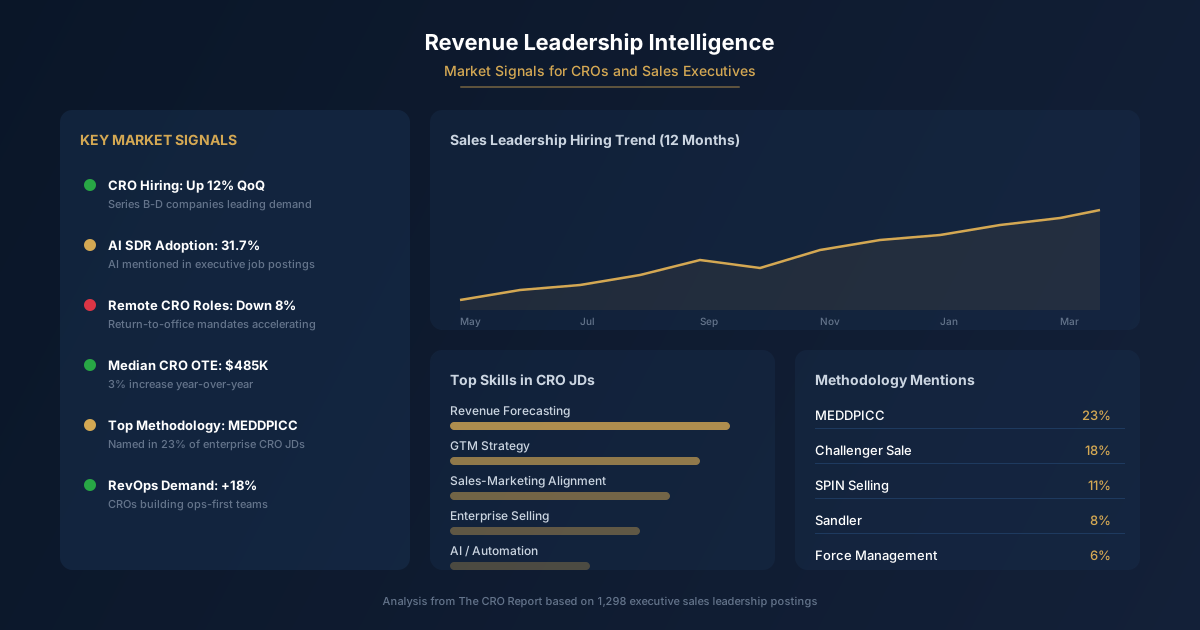
Sales hiring trends look different when you track live executive job postings instead of asking leaders how optimistic they feel.
This dataset contains 1,298 executive sales postings across 9 weeks, pulled from major job boards and company career pages and analyzed weekly. Related analysis Hiring volume reached 232 postings in late November, then the last week of January had 11 postings, a 90.5% drop from the peak. Related analysis
That movement is an observation, not a market forecast. Posting activity can move sharply around holidays, budget cycles, collection timing, and when companies choose to publish roles. The useful part is seeing what employers asked for while those jobs were live.
The postings skew heavily toward senior leaders. Companies were hiring people to own revenue systems, hiring plans, forecasting discipline, executive relationships, and the uncomfortable job of explaining why a sales number moved.
TLDR
Sales hiring trends in this tracked dataset show a sharp fall from the late-November posting peak to the last week of January. VP roles dominated, salary disclosure was uneven, and AI or ML appeared often enough to show up in executive sales job descriptions.
Key Takeaways
Hiring volume reached 232 postings in late November before falling to 11 postings in the last week of January.
VP-level roles make up 90.3% of the dataset.
Salary ranges appeared in 704 roles, or 54.2%, leaving many candidates without a public compensation range.
AI and ML appeared in 411 of 1,298 postings, or 31.7%.
Sales Hiring Trends at a Glance
The dataset contains 1,298 executive sales postings across 9 weeks. Related analysis These are live roles, not survey responses. That distinction matters because surveys capture what respondents say they expect; job descriptions show what companies were willing to put into a requisition.
A posting is still a messy signal. Some employers repost roles. Some leave them open longer than intended. Some write an aspirational description that bears only a loose resemblance to the person they eventually hire. But a weekly collection of live postings is far more useful than a single executive declaring that “the market feels tighter.”
The highest-volume week recorded 232 postings in late November. Related analysis The final tracked week recorded 11 postings, a 90.5% drop from that peak. Related analysis That is a large movement in a short collection window.
Candidates should resist turning that movement into a personal verdict. A slower posting week does not mean companies stopped needing sales leadership. It means fewer eligible roles appeared in this tracked collection during that week. Those are different claims, and only one is supported here.
Hiring leaders should read the same data with a little humility. Public postings tell candidates where demand is visible. They do not capture retained searches, internal successors, confidential replacements, or roles that never made it past a recruiter’s inbox. A company can be hiring aggressively and still look quiet on public boards.
The jobs that did appear were overwhelmingly senior. VP-level roles make up 90.3% of the dataset. Related analysis This was not a broad sample of every sales job in the market. It was a window into executive sales hiring, where employers are looking for someone who can take responsibility for a revenue number.
That changes the reading of every other finding. A VP of Sales posting will ask for broader operating judgment than an account executive role. It will mention hiring, territory design, forecast calls, board communication, pricing discipline, channel conflict, and systems because those are part of the job.
Hiring Volume and Salary Disclosure
Public compensation is one of the clearest places where the hiring market still makes candidates do extra work.
Salary ranges appeared in 704 roles, or 54.2%, of the dataset. Related analysis That leaves a substantial portion of executive postings without a published range, even in roles where pay structure shapes whether a candidate should spend time on the process.
A disclosed range does not settle the question. It may cover a broad geographic footprint. It may leave variable compensation vague. It may say little about equity, ramp expectations, quota, account ownership, or whether the company has a sales motion worth inheriting. Still, it gives candidates a starting point.
The average maximum base salary declined 10.1%, from $253K to $227K, over the tracking period. Related analysis The collection window is too narrow to turn that into a sweeping compensation thesis. It does show why candidates should look beyond a single attractive top-end number in a job post.
Base salary is only part of the economic picture. A senior sales leader can have a high base and still walk into a bad deal if the quota is detached from the market, the territory is carved up badly, or the company treats headcount as a substitute for product demand. The role description often gives away more than the range does.
Pay language also tells you how much work the company has done before opening the search. A clear range, reporting line, team scope, and stated business problem usually point to a role that has been thought through. A vague mandate to “drive growth” can mean the company wants an answer before it knows the question.
The same goes for NTE compensation, especially when the average maximum base salary declined 10.1%, from $253K to $227K. Related analysis Candidates need the full on-target picture, not a base number designed to get them into the first call.
Hiring leaders have an incentive to be more specific. Senior candidates are not browsing job boards for entertainment. They are deciding whether a role is worth the political cost of leaving a current team, the career risk of joining a new company, and the time required to run a serious interview process.
A vague compensation description attracts noise. A clear one filters for people who can plausibly take the job.
Skills Companies Request
AI and ML appeared in 411 of 1,298 postings, or 31.7%. Related analysis That does not mean every company was hiring an AI sales specialist. It means AI and machine learning appeared often enough in executive sales descriptions to be part of the market’s vocabulary.
In some roles, that language likely referred to the product being sold. In others, it referred to how a sales organization is expected to operate: better account research, cleaner forecasting, faster coaching, more disciplined pipeline work, and a tighter connection between revenue data and management decisions.
The executive sales job has always required judgment. The current descriptions suggest companies also want leaders who can work from evidence rather than instinct alone. A forecast call still needs someone willing to challenge a rep’s close date. Software can flag a pattern; it cannot force an honest conversation about a weak deal.
That is where candidates should separate tool familiarity from operating skill. Listing a stack of sales tools is easy. Explaining how you used data to change coverage, coaching, hiring, or pipeline inspection is harder. It is also closer to what a company is paying an executive to do.
The strongest candidates will have examples that connect the two. They can explain the reporting problem, the behavior they changed, and the revenue consequence. They do not need to pretend every sales decision is an algorithmic exercise. Most are not.
Hiring leaders should be equally careful with their wording. Asking for “AI experience” without describing the business problem produces generic resumes and vague interview answers. Asking for someone who can improve forecast quality, identify stalled opportunities, or build a more accountable sales process gives candidates something real to respond to.
The broader theme is operational. Executive sales roles increasingly ask for leaders who can build and run a data-informed revenue engine, rather than simply manage a group of sellers. That is a higher bar, but it is also more honest about the job.
A leader who only rallies the room can be useful. A leader who can diagnose why the room missed the number is more valuable.
Seniority Tells You What Companies Are Buying
VP-level roles make up 90.3% of the dataset. Related analysis Companies were largely advertising for senior ownership, not incremental capacity.
Seniority tier
Share of dataset
What the posting signals
VP-level
90.3%
Ownership of a revenue organization and its operating cadence
Other executive roles
n/a
Senior sales leadership outside the dominant VP-level group
This concentration affects how candidates should approach the search. A senior sales role is rarely won through a polished resume alone. The hiring team wants evidence that you have dealt with the parts of the job that become visible when things go wrong: missed quarters, weak managers, churn, forecast gaps, territory fights, board pressure, and a plan that sounded better before it met customers.
The candidate who tells clean success stories may still do well. The candidate who can explain a difficult diagnosis usually has the edge. Sales leadership is not a highlight reel. It is a job of seeing a problem early enough to fix it before the company spends another quarter explaining it away.
For employers, the VP concentration should raise another question: is the mandate proportionate to the role? A company cannot hire one senior person and expect them to repair product fit, demand generation, pricing, enablement, retention, and morale without deciding which problem matters first.
That is how expensive executive searches become a literal money pit. If leadership wants a sales executive to fix economics, they should be able to explain the cost of revenue with the same seriousness they bring to a $227K average maximum base salary. Related analysis
Where Executive Sales Demand Appears
The postings cover a mix of industries, but the data supports a more useful point than a generic sector ranking. Executive sales demand shows up where companies need someone to turn a complex product, a fragmented market, or an uneven go-to-market motion into a repeatable revenue process.
AI and ML appeared in 411 of 1,298 postings, or 31.7%. Related analysis That makes AI-related language one visible part of the executive sales market. It also reflects a wider pressure on leaders to understand technical products well enough to sell them, hire for them, and build a team around them.
A company selling into technical buyers needs more than enthusiasm. It needs a sales leader who can decide when a rep should bring in a specialist, when a proof of concept is drifting, and when the product team is being asked to rescue a deal that was never qualified properly.
The same operating pressure appears outside AI. Enterprise software, services, financial products, industrial systems, and other complex sales motions all reward leaders who can create clarity around account selection, deal stages, customer economics, and team accountability.
That is why seniority matters here. VP-level roles make up 90.3% of the dataset. Related analysis Employers were posting jobs for people expected to influence the entire commercial system, even when the title only says sales.
Candidates should look for the real mandate behind the category label. Is the company trying to open a new market? Repair a founder-led sales motion? Build a team after early traction? Add enterprise discipline? Recover from churn? Each requires a different operator.
The job title might be identical. The job is not.
What Candidates and Hiring Leaders Should Do With This
Candidates should treat the posting as a due-diligence document. Read it for the stated responsibilities, then read it for the omissions. If the role asks for rapid growth but says nothing about current team structure, territory ownership, sales cycle, or compensation design, bring those questions into the conversation.
The volume movement also argues for patience. Hiring volume reached 232 postings in late November, while the last week of January had 11 postings, a 90.5% drop from the peak. Related analysis A weekly collection can move sharply. You do not need to rewrite your career strategy every time a board looks thin.
Hiring leaders should make their postings more useful. State the business problem. Describe the team and reporting line. Publish the compensation range where possible. Explain what success looks like in the role. Good candidates will still ask hard questions, but they will arrive with a better understanding of the work.
The newsletter follows live executive hiring signals, including the 1,298 executive sales postings tracked across 9 weeks. Related analysis That weekly view is more useful than pretending one posting spike or one quiet week can explain the entire sales market.
The market is asking for senior sales operators who can run the machine, inspect the machine, and explain where the machine is breaking. Can companies define that job clearly enough to hire the right person?
Are sales executive hiring rates increasing or decreasing in 2026?
Based on 1,298 executive sales postings tracked by The CRO Report, hiring volume dropped significantly during the holiday weeks (late December into early January), bottoming at 11 postings in the last week of January 2026. January showed early recovery with 73-89 postings per week in the first two full weeks, but volumes haven't returned to the 232-posting peak seen in late November 2025. The trend suggests a cautious start to 2026 hiring.
What skills are companies looking for in VP Sales candidates?
The top signals in VP Sales job postings are Scale (591 mentions), GTM strategy (488), AI/ML (411), Data-Driven leadership (341), and SaaS experience (262). Companies increasingly want sales leaders who can build and operate data-informed revenue engines, rather than just manage teams. AI/ML appeared in 31.7% of all postings, making it the fastest-growing requirement in sales executive hiring.
Which industries are hiring the most sales executives?
Healthcare (720 postings), Tech (719), Education (626), and Financial Services (589) lead executive sales hiring. Healthcare and Tech are nearly tied at the top, which reflects ongoing digital transformation spend in both sectors. Education's strong showing at 626 postings is driven by EdTech companies scaling their enterprise sales motions.
Are VP Sales salaries going up or down?
Down, based on recent data. Over the past 9 weeks, average max base salary across executive sales roles declined 10.1%, from $253K in late November 2025 to $227K in late January 2026. Some of this is seasonal compression during Q4/Q1 transitions. Whether it reverses in Q1 2026 will be a key signal. Weekly salary data from 704 roles with disclosed compensation shows the trend clearly.
How common is AI experience as a requirement for sales leadership roles?
AI/ML appeared in 411 of 1,298 executive sales postings tracked by The CRO Report, or 31.7%. That makes it the third most common keyword after Scale (591) and GTM (488). Companies don't expect sales leaders to build models. They want leaders who can sell AI products, use AI tools in the sales process, and articulate AI value propositions to enterprise buyers.
Methodology & Disclosure: All data comes from publicly posted job listings tracked weekly by The CRO Report from November 2025 through January 2026. The market intelligence dataset covers 1,298 executive sales postings analyzed for skills, tools, industries, and keyword signals. The compensation dataset covers 1,349 postings with a broader collection window, of which 704 (54.2%) disclosed salary ranges. Seniority classifications (VP, SVP, C-Level, EVP) are based on job title analysis. Company stage data is derived from publicly available funding information. Industry tags reflect the primary markets served by the hiring company and may overlap. Weekly posting volume reflects new postings identified during each collection period and may undercount roles posted and filled within the same week. Updated January 31, 2026.
The CRO Report is run by Rome Thorndike, VP Revenue at Firmograph.ai. 15+ years in B2B sales leadership including Salesforce, Microsoft, Snapdocs, and Datajoy (acquired by Databricks). MBA from UC Berkeley Haas.